Guide · checked November 2026
Cath lab scheduling and list planning
Good cath lab scheduling plans elective lists around protected capacity for acute work. GIRFT's cardiology report recommends a coordinator using a scheduler, at least one hot lab for NSTEMI and primary PCI around the clock where there is a suite of labs, acute coronary syndrome lists seven days a week, patients ready before their slot, and day-case beds or a radial lounge so recovery does not block the lab.
What GIRFT recommends
- A coordinator runs the lab using a scheduler that allows optimal flow, particularly for non-elective work.
- Where there is a suite of labs, at least one is a hot lab for non-elective and acute cases (NSTEMI, rapid NSTEMI and primary PCI) 24/7.
- Elective labs flex to take emergency work when the hot lab is busy.
- Acute coronary syndrome lists run seven days a week and are open to every hospital in the network; weekend cover can be organised at network level.
- Patients are ready well before their allocated time, so another case can be sent for if one does not go ahead, and a holding bay helps turnaround.
- Dedicated, ring-fenced day case beds or a radial lounge, so activity in the lab is not interrupted.
- Consultants are not expected to run elective lists while on call: on-call should be protected time.
GIRFT also recommends electronic rostering, which it says gives clear demarcation of sessions that can feed into job planning.
Planning for urgent and emergency work
GIRFT says primary PCI should be delivered on a network basis by centres providing a continuous 24/7/365 service, with rotas of at least one in six, a view it shares with BCIS. Every hospital providing PCI must have a cath lab team on a rota to cover unplanned returns to the lab 24/7. For acute coronary syndromes, GIRFT cites access to PCI within 72 hours, within 24 hours for higher-risk patients and within 2 hours for those at very high risk, and says these targets can only be met if lists run seven days a week. NICE's quality standard QS68 includes coronary angiography and PCI within 72 hours for NSTEMI or unstable angina.
In practice this means holding slots, or a whole lab, for work that has not yet arrived, and deciding in advance which elective cases move when it does.
Where lab time is lost
- Patients not ready when their slot comes: missing results, consent or a medicines plan.
- Recovery happening in the lab because there is no bed or chair outside it.
- General anaesthetic: GIRFT calls GA resource-intensive and a major contributor to turnaround times, because induction and recovery often take place in the lab, and suggests many first-time AF ablations can be done under conscious sedation.
- Work that does not need a cath lab, such as routine cardioversions, which GIRFT says should not be done there routinely.
What a scheduling view should show
- Each room's list, with planned times and the procedure for each case.
- Readiness per patient, with open blockers and who owns them.
- Protected emergency capacity, and what moves when it is used.
- Actual start times, case durations and turnaround between cases, so the plan can be compared with what happened.
Common mistakes
- A full list is not good utilisation if cases overrun or the lab waits for a recovery space.
- A hot lab is not idle capacity: GIRFT expects elective labs to flex and the hot lab to absorb acute work.
- Software cannot fix flow on its own without ready patients and recovery space.
Where Cath Copilot fits
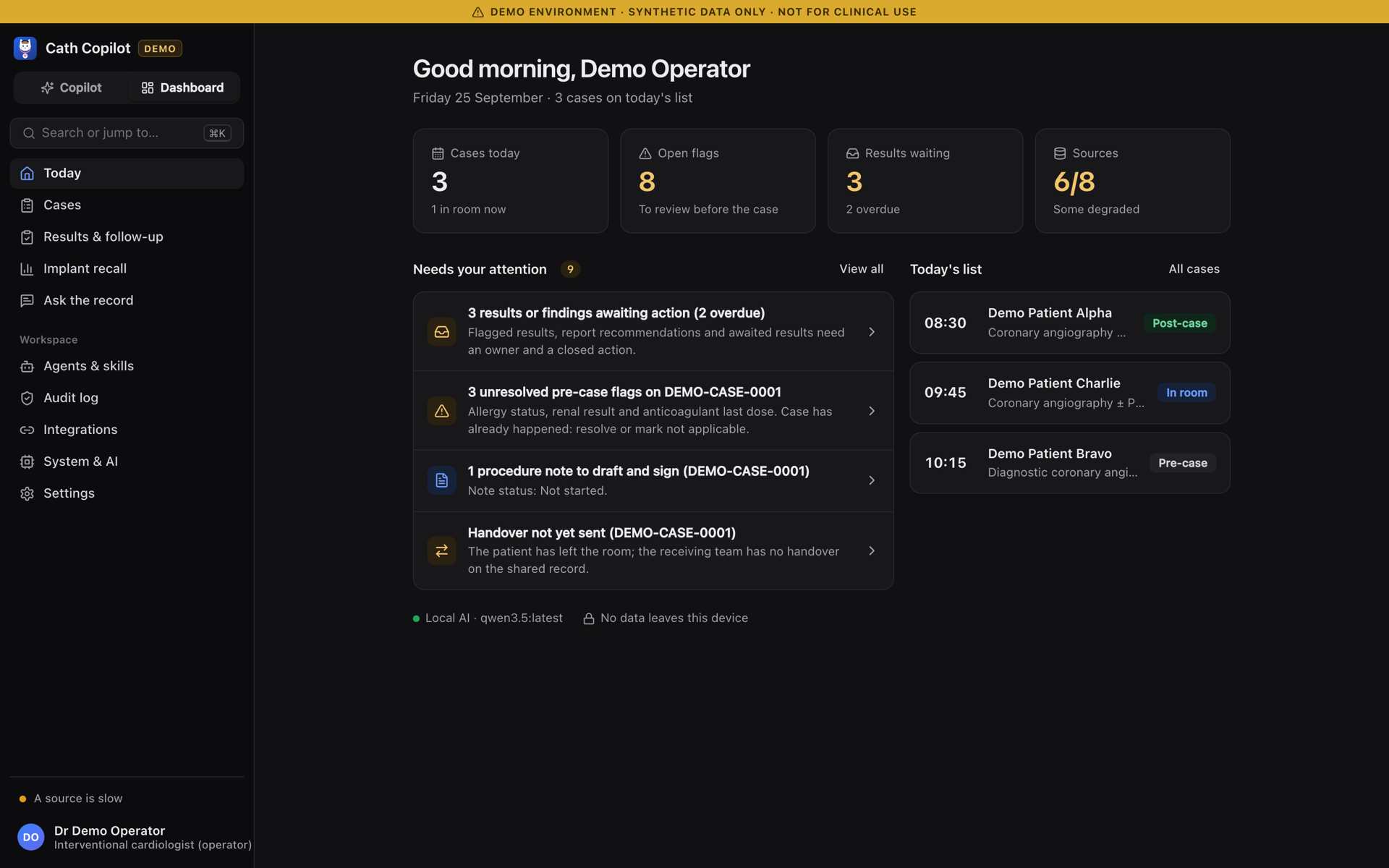
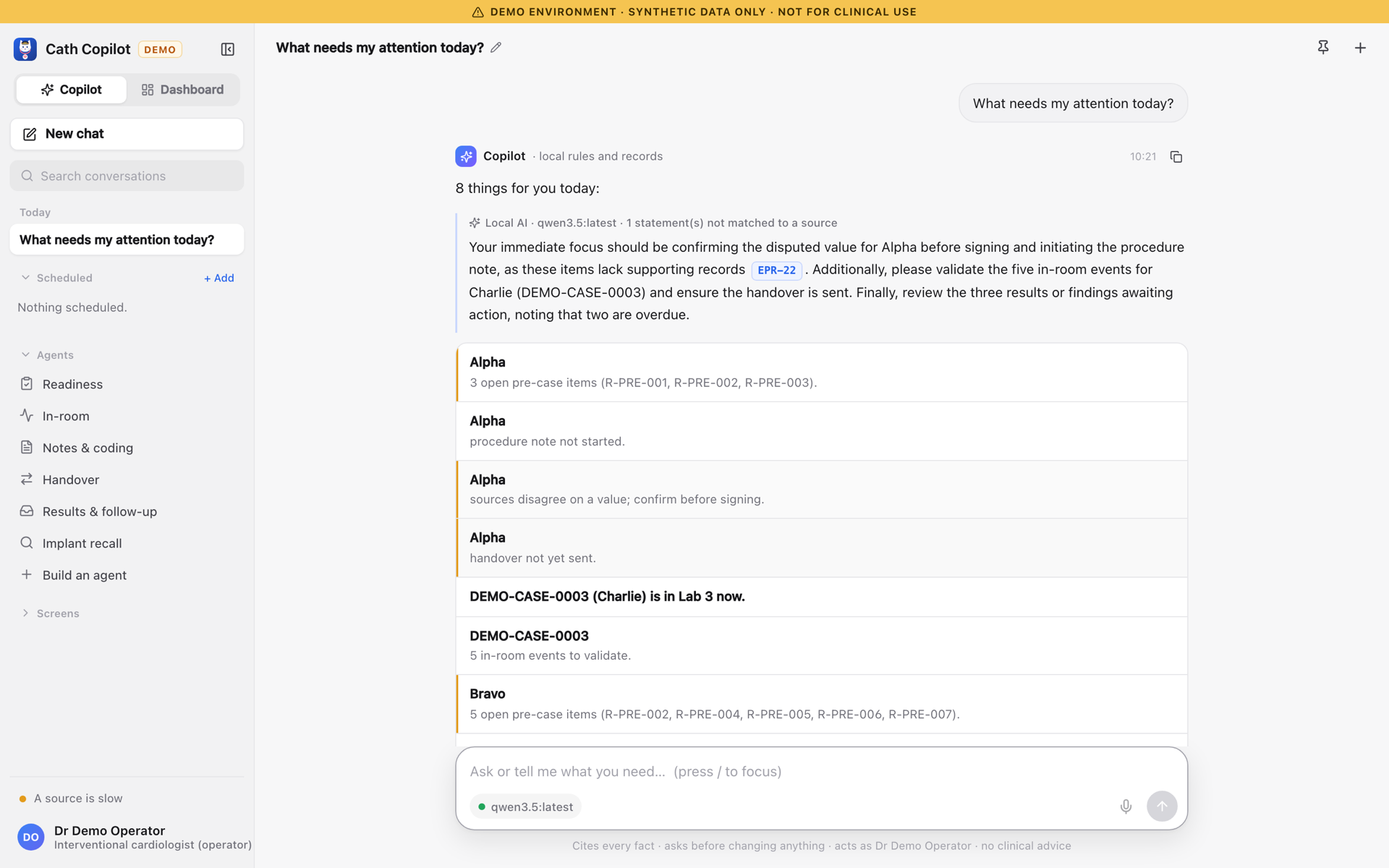
Cath Copilot is not a scheduler. It reads the day's list from the RIS and shows readiness against it: Today's list, as a table or room lanes, with counters for cases, cases in room, open pre-case flags and notes to sign. When the RIS moves a case to another room, the list updates without a reload. A wall board for the huddle room shows each room lane with a readiness status, open flags and events to validate per case, and never shows names or clinical values. Pre-case flags can be assigned to the coordinator, and a scheduled morning request can list what needs attention before the first case.
A Lab Operations module for utilisation and turnover is planned but not built. Cath Copilot is a prototype on synthetic data only. It is not a medical device and is not for clinical use.
 Cath Copilot: An AI copilot for the cath labWatch the demo on synthetic data, then see how it works →
Questions
What is a hot lab?
A cath lab kept for non-elective and acute cases, such as NSTEMI and primary PCI, around the clock. GIRFT recommends one wherever there is a suite of labs.
How can a cath lab improve utilisation?
GIRFT points to ready patients, a holding bay, ring-fenced day case beds or a radial lounge, flexing elective labs, and conscious sedation instead of general anaesthetic where it is safe.
Does Cath Copilot book or schedule patients?
No. It reads the list from the RIS and shows readiness, open flags and progress for each case.
Sources
Official pages, checked November 2026. Guidance changes, so check the current version before you rely on it.
General information for healthcare managers and clinical teams, checked November 2026. It is not legal, regulatory or clinical advice; follow the current official guidance and your organisation's own policies. No patient data is used in these examples. Cath Copilot is a prototype running on synthetic data only. It is not a medical device and is not for clinical use. It recommends, drafts, and routes; it never diagnoses, orders, or decides. A clinical safety and information-governance process precedes any use with real patient data.