
Guide · checked November 2026
Cath lab workflow: from referral to discharge
A cath lab workflow runs from referral and booking, through pre-assessment and readiness checks, admission and a morning team huddle, to the safety checks and the procedure, then recovery, handover, documentation and discharge. GIRFT's cardiology report recommends running the lab with a coordinator and a scheduler, having patients ready before their slot, and using same-day discharge where it is appropriate.
The patient journey, step by step
- Referral and booking: the referrer requests the procedure, the case is placed on a list and the patient is given a date, or is added to an urgent or emergency list.
- Pre-assessment: NHS patient information describes blood tests and a general health check before a coronary angioplasty, and a review of medicines. Most medicines continue as normal; blood-thinning medicines such as warfarin are the usual exception, and diabetes medicines may need retiming.
- Readiness: before the day, someone checks that results, allergies, consent, the medicines plan and the planned access route are in place, so problems are found while there is still time to fix them.
- Admission: the patient is checked in on the day, ideally to a holding bay or day ward close to the lab.
- Team huddle: the lab team meets at the start of the day to introduce themselves, run through the list and check the equipment.
- Safety checks: sign in and time out before the case, following NatSSIPs and the local LocSSIP.
- The procedure: access through the wrist or groin, imaging, any treatment, and closure of the access site.
- Recovery: monitoring of the patient and the access site in a recovery area, day ward, coronary care unit or ward.
- Handover, documentation and discharge: the procedure note, national audit data, discharge advice, medicines and follow-up.
What GIRFT recommends for flow
The GIRFT national cardiology report (February 2021) says the cath lab should be run by a coordinator using a scheduler that allows optimal flow through the lab, particularly for non-elective work, with dedicated ring-fenced day case beds or a radial lounge. It recommends a huddle at the start of each day with the whole team present, a WHO checklist with the whole team before each case, a debrief after a difficult case and at the end of the day, and a full debrief for every death in the cath lab.
On patient readiness, GIRFT says elective patients should be pre-admitted virtually where possible, and that non-elective patients should preferably be seen on arrival by an advanced clinical practitioner or specialist nurse, consented and pre-medicated. Patients should be ready well before their allocated time, so that if a case does not go ahead another can be sent for, and a holding bay helps turnaround and utilisation. GIRFT also recommends the radial approach by default and same-day discharge for elective patients and most NSTEMI patients, where appropriate.
Elective, urgent and emergency routes
Elective patients come through a booked list. Urgent inpatients, such as people with NSTEMI or unstable angina, need a slot within days: NICE's quality standard QS68 includes coronary angiography and PCI within 72 hours for NSTEMI or unstable angina, and GIRFT recommends acute coronary syndrome lists seven days a week. Emergency primary PCI for STEMI runs around the clock, which is why GIRFT recommends a designated hot lab where there is a suite of labs.
After the patient leaves the room
NHS information says that after a planned coronary angioplasty most people go home the same day or the following day, with advice on medicines, wound care and recovery, and that most people take blood-thinning medicines for up to a year. Behind the scenes the team still has to sign the procedure note, complete the national audit return, hand over to the receiving ward and make sure results and follow-up have an owner. These steps are often done hours after the case, which is where values drift and items get lost.
Where the workflow usually breaks
- Readiness gaps found on the morning of the case, such as an old blood result or an anticoagulant with no documented last dose.
- The next patient is not ready when a case is cancelled, so the slot is lost.
- No recovery space, so the patient recovers in the lab and the next case waits.
- Documentation and audit data reconstructed later from several systems.
Where Cath Copilot fits
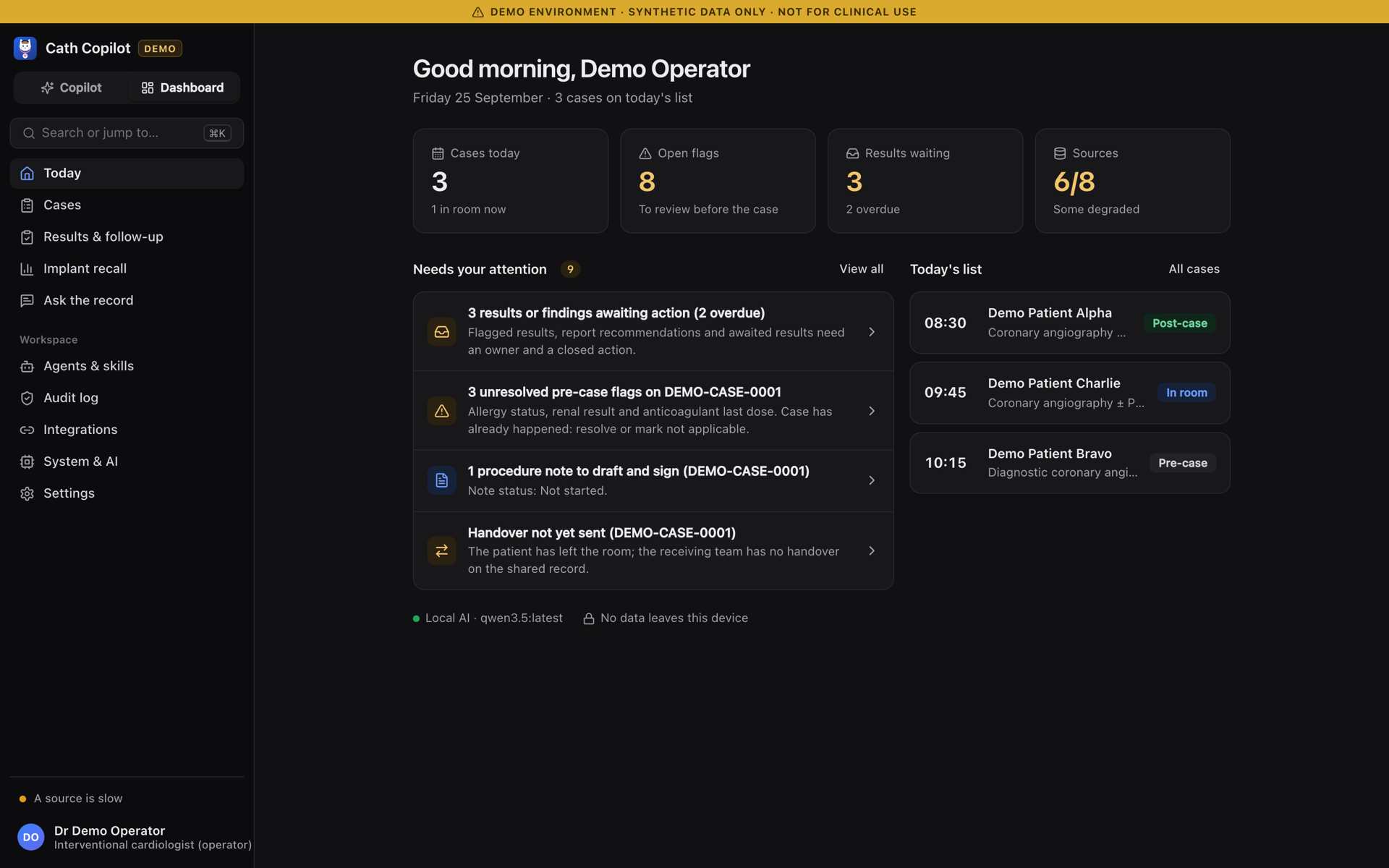
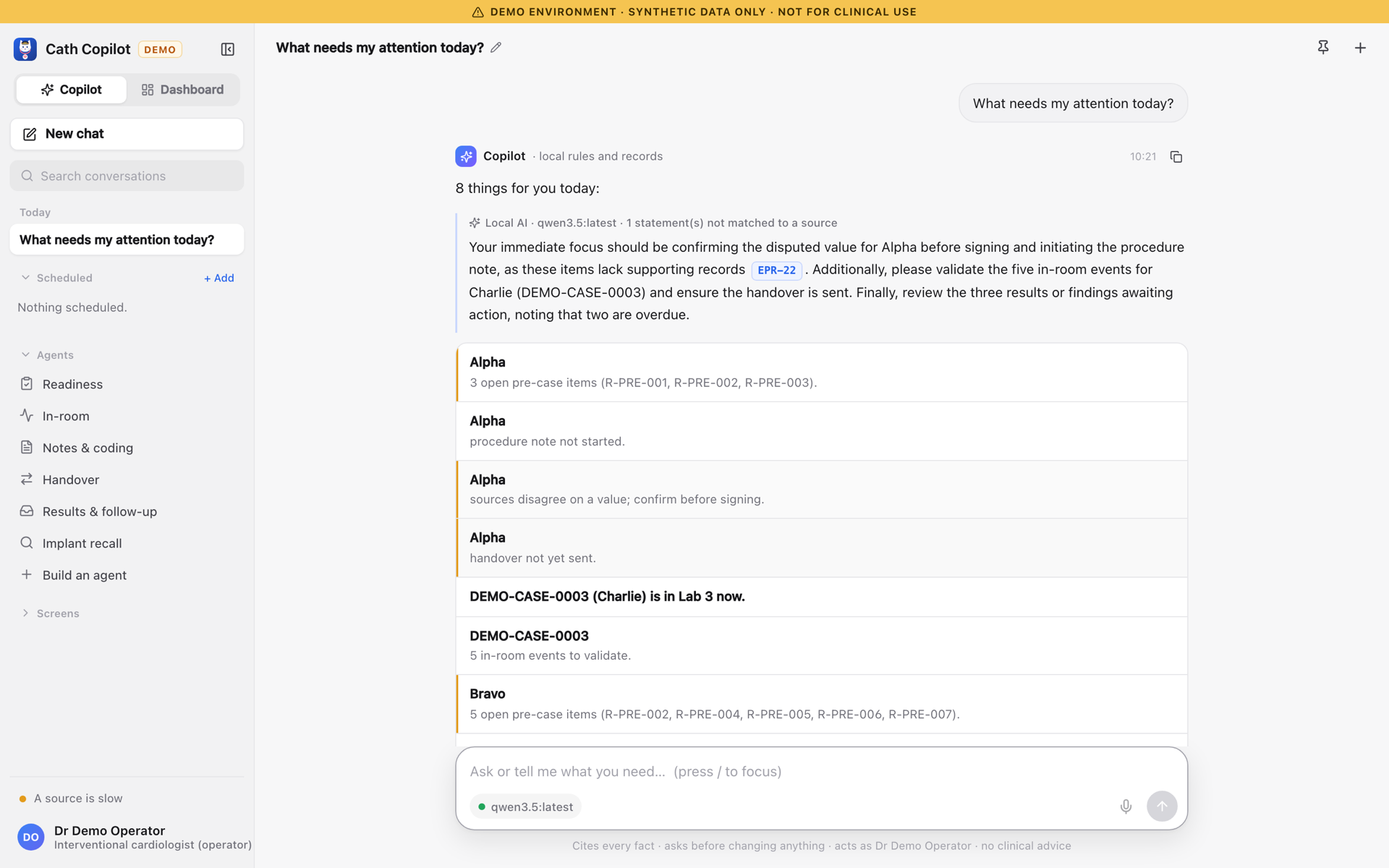
Cath Copilot follows the case from the list to closing the loop. Today's list reads the cases from the RIS and shows the readiness of each one, as a table or as room lanes. The pre-case brief shows every field with its source record, and deterministic local rules flag gaps for a person to resolve, assign or escalate. In the room, the timeline records milestones such as patient in room, safety time-out completed, arterial access obtained, access closed and patient out of room, for the team to validate. After the case it drafts a cited procedure note, pre-fills the audit return and drafts a handover that the receiving nurse acknowledges, and it tracks results and follow-up until a named person closes them.
It does not book patients or build the list. Cath Copilot is a prototype on synthetic data only. It is not a medical device and is not for clinical use.
 Cath Copilot: An AI copilot for the cath labWatch the demo on synthetic data, then see how it works →
Questions
What are the main stages of a cath lab workflow?
Referral and booking, pre-assessment and readiness checks, admission, the team huddle, sign in and time out, the procedure, recovery, then handover, documentation and discharge.
How long does a coronary angioplasty take?
NHS information says it usually takes between 30 minutes and 2 hours, although it can take longer.
Do cath lab patients go home the same day?
Often. NHS information says most people go home the same day or the next day after a planned angioplasty, and GIRFT recommends considering same-day discharge for elective patients and most NSTEMI patients.
Sources
Official pages, checked November 2026. Guidance changes, so check the current version before you rely on it.
General information for healthcare managers and clinical teams, checked November 2026. It is not legal, regulatory or clinical advice; follow the current official guidance and your organisation's own policies. No patient data is used in these examples. Cath Copilot is a prototype running on synthetic data only. It is not a medical device and is not for clinical use. It recommends, drafts, and routes; it never diagnoses, orders, or decides. A clinical safety and information-governance process precedes any use with real patient data.