
Guide · checked November 2026
Cath lab KPIs: what to measure and why
Useful cath lab KPIs fall into five groups: flow (session use, start times, turnaround and on-the-day cancellations), timeliness (door-to-balloon and call-to-balloon for primary PCI, NSTEMI within 72 hours), quality (radial access, same-day discharge and the national PCI audit's metrics), safety (patient dose against reference levels and safety-check compliance) and data quality (complete, timely audit returns). Anchor each one to a national standard where one exists.
Flow
- Session utilisation: time used for cases against time available.
- First-case start time against the planned start.
- Turnaround time between cases.
- On-the-day cancellations, with the reason for each.
- Time patients spend recovering in the lab because no recovery space is free.
We found no national numeric target for cath lab utilisation or turnaround in the sources we checked, so set a local baseline and track the trend. GIRFT names general anaesthetic as a major contributor to turnaround, because induction and recovery often happen in the lab.
Timeliness
- Door-to-balloon for primary PCI: the BCIS standard, cited by NICE indicator IND73, is at least 75% of patients under 60 minutes from arrival at a primary PCI centre.
- Call-to-balloon: the NAPCI standard, cited by NICE indicator IND74, is 75% of patients under 150 minutes from the call for help.
- NSTEMI and unstable angina: NICE's quality standard QS68 includes angiography and PCI within 72 hours, and GIRFT cites 24 hours for higher-risk patients and 2 hours for those at very high risk.
Quality and outcomes
- Radial access rate: GIRFT recommends the radial approach by default.
- Same-day discharge: GIRFT recommends considering it for elective patients and most NSTEMI patients.
- Day-case rate for device implants: GIRFT reported day-case rates for cardiac rhythm management procedures ranging from 1% to 98% between trusts, with a national average of 47% (April 2017 to March 2019).
- The national PCI audit's quality metrics: NICOR's 2026 interim NAPCI summary reported on STEMI treatment times, the use of newer P2Y12 antiplatelet drugs, intracoronary imaging in complex PCI and drug-eluting balloons for restenosis.
- Complications and outcomes, reviewed case by case as potential events for review.
Safety
- Patient dose (dose-area product and fluoroscopy time) compared with local and national diagnostic reference levels.
- Observed compliance with sign in, time out and sign out.
- Significant accidental or unintended exposures, and how quickly they were investigated.
Data quality
- Completeness of national audit records, field by field.
- Time from procedure to audit submission.
- Agreement between the procedure note, the audit record and the source systems.
Making KPIs useful
Write down how each KPI is defined, where its times and values come from and who owns it. Report proportions within a standard rather than averages where the standard is a proportion, and make it possible to open the individual cases behind a number.
Common traps
- Very high utilisation is not the aim if acute cases then wait for a lab.
- A good median can hide a long tail of slow cases.
- A KPI without a written definition will be counted differently by different people.
Where Cath Copilot fits
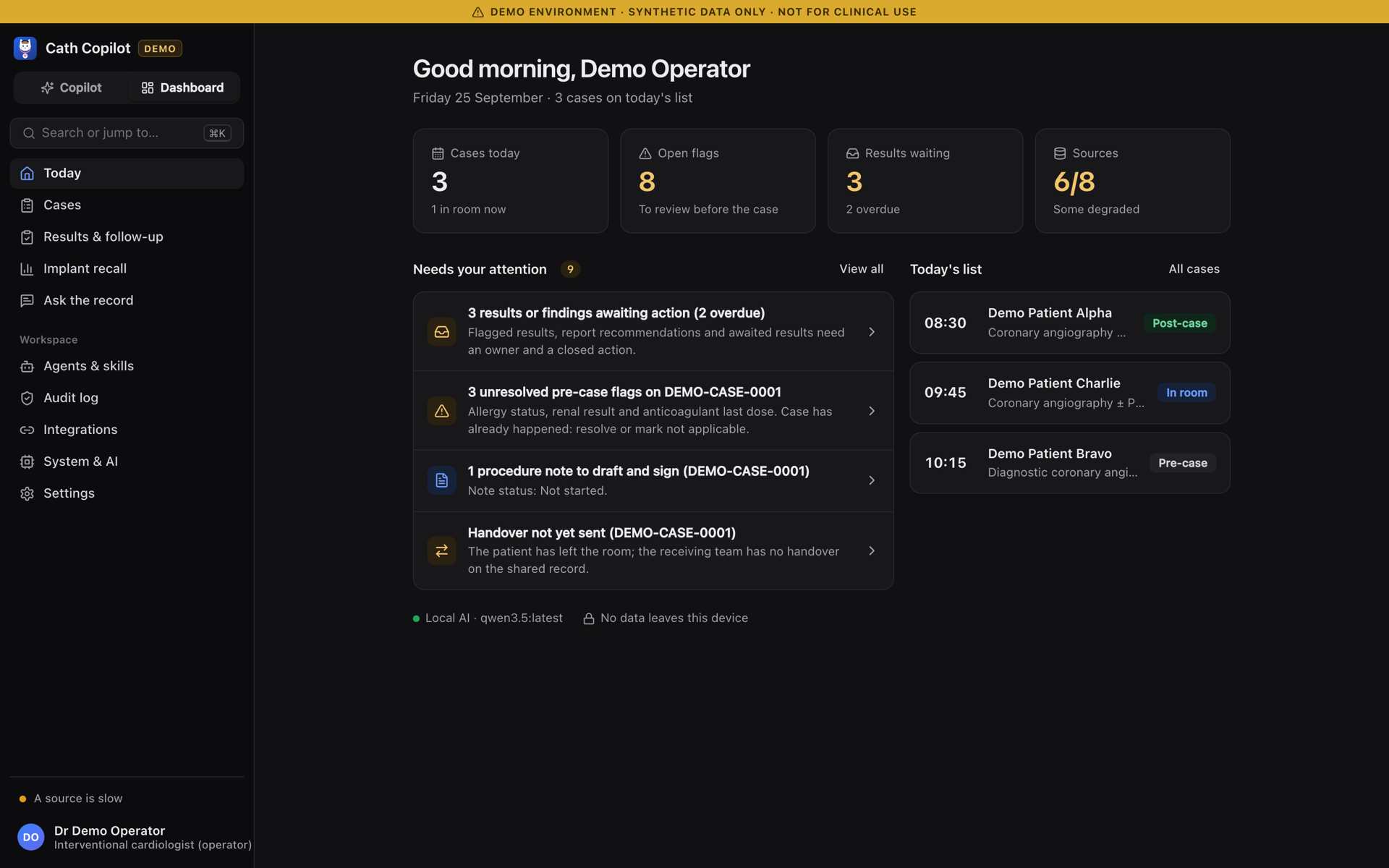
Cath Copilot shows live counters on Today's list: cases in total, cases in room now, open pre-case flags and notes to sign. The wall board shows readiness per case by room, and the quality review queue counts missing registry fields, potential events for review and reconciliation overrides. Because each value in the note and audit return is cited to its source, the cases behind a data-quality number can be checked.
It does not yet calculate utilisation, turnaround or door-to-balloon: a Lab Operations module for utilisation and turnover is planned, not built. Cath Copilot is a prototype on synthetic data only. It is not a medical device and is not for clinical use.
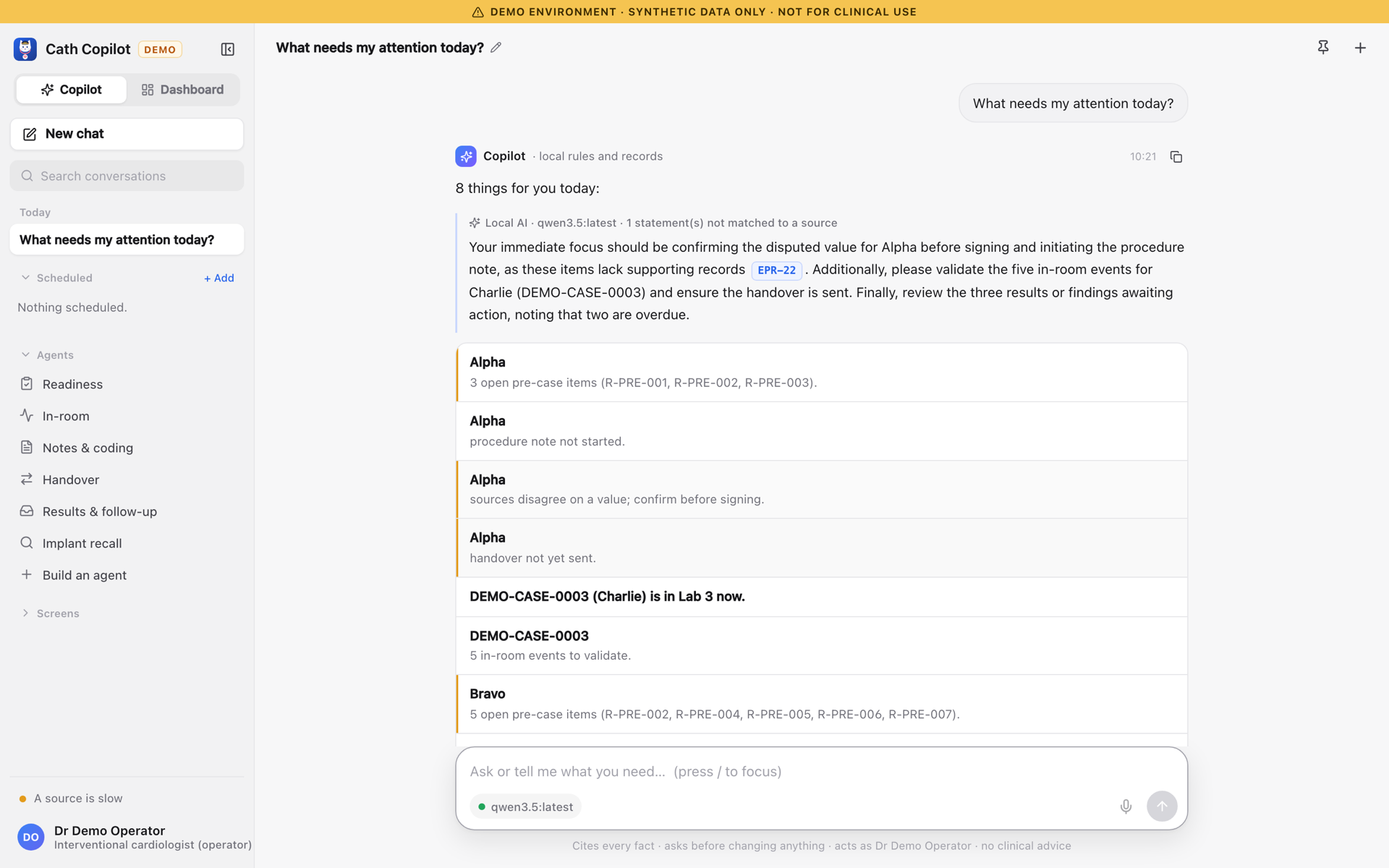 Cath Copilot: An AI copilot for the cath labWatch the demo on synthetic data, then see how it works →
Questions
What is a good cath lab utilisation rate?
We found no national numeric target in GIRFT, NICE or NICOR sources. Set a local baseline and track it alongside cancellations and turnaround.
Which cath lab KPIs have national standards?
Door-to-balloon and call-to-balloon for primary PCI (via NICE indicators IND73 and IND74), and angiography and PCI within 72 hours for NSTEMI (NICE QS68).
Are cath lab KPIs the same as NAPCI metrics?
Partly. NAPCI reports quality metrics for PCI; flow measures such as utilisation and turnaround are local.
Sources
Official pages, checked November 2026. Guidance changes, so check the current version before you rely on it.
- GIRFT: Cardiology national specialty report (February 2021)
- NICE indicator IND73: Myocardial infarction, PCI in less than 60 minutes
- NICE indicator IND74: Myocardial infarction, PCI rates (call to balloon)
- NICE QS68: Acute coronary syndromes in adults, quality statements
- NICOR: National Audit of Percutaneous Coronary Interventions (NAPCI)
General information for healthcare managers and clinical teams, checked November 2026. It is not legal, regulatory or clinical advice; follow the current official guidance and your organisation's own policies. No patient data is used in these examples. Cath Copilot is a prototype running on synthetic data only. It is not a medical device and is not for clinical use. It recommends, drafts, and routes; it never diagnoses, orders, or decides. A clinical safety and information-governance process precedes any use with real patient data.