
Guide · checked November 2026
Door-to-balloon time in primary PCI: targets and measurement
Door-to-balloon time is the interval from a STEMI patient's arrival at a hospital with primary PCI facilities to balloon inflation. NICE indicators cite the BCIS standard, referenced by the national PCI audit, that at least 75% of patients should have a door-to-balloon time under 60 minutes, and a NAPCI standard that 75% should have a call-to-balloon time under 150 minutes. NICE's overall rule is primary PCI within 120 minutes of when fibrinolysis could have been given.
The intervals
- Door-to-balloon: from admission at a centre with primary PCI facilities to balloon inflation (NICE indicator IND73).
- Call-to-balloon: from the call for help to balloon inflation (NICE indicator IND74). The PCI dataset defines the call for help as the time of the first call by the patient, a relative or an attendant, to a GP, NHS Direct or the ambulance service. For people who walk into A&E it is arrival at the first hospital; for people already in hospital or on their way when the STEMI develops, it is the time of the diagnostic ECG.
- The NICE window: primary PCI within 120 minutes of the time when fibrinolysis could have been given, for people presenting within 12 hours of symptom onset (NG185 recommendation 1.1.6).
UK targets and standards
NICE guideline NG185 says reperfusion should be delivered as quickly as possible, and recommends angiography with follow-on primary PCI as the preferred strategy when it can be delivered within 120 minutes of when fibrinolysis could have been given; if it cannot, it recommends fibrinolysis. Quality statement 6 of NICE's QS68 turns this into measures: the proportion of eligible adults who have primary PCI within 120 minutes of when fibrinolysis could have been given, the proportion within 150 minutes of the call for help, and evidence that primary PCI is available 24 hours a day.
NICE's indicators add the cath lab-facing standards. IND73 measures the proportion of STEMI patients treated with primary PCI who have balloon inflation within 60 minutes of admission at a primary PCI centre, and cites the BCIS position that at least 75% should. IND74 measures the median call-to-balloon time and cites the NAPCI standard that 75% of patients should be under 150 minutes. Both exclude patients presenting in cardiogenic shock and patients who need ventilation before PCI, and both are meant to be read at network or system level.
How it is measured and audited
The times come from the PCI dataset that units submit to NAPCI, and QS68 notes that MINAP collects time-to-PCI fields too. NICOR's 2026 interim NAPCI summary reported a slight improvement in STEMI treatment times, especially for patients who needed an inter-hospital transfer.
Because each interval spans several teams and systems, the measurement is only as good as the timestamps. Record the call time, arrival at the first hospital, arrival at the PCI centre, arrival in the lab, arterial access and the first balloon inflation, each from its source, on clocks that agree. Review the longest cases one by one rather than relying on the median.
What usually adds delay
- Inter-hospital transfer, when the patient first arrives at a hospital without primary PCI.
- Self-presentation: NICOR's MINAP summary for 2026 reported high rates of people with STEMI presenting to hospital themselves rather than calling an ambulance.
- Assembling the team out of hours, which is why GIRFT recommends a hot lab and a 24/7 network rota.
Common confusions
- Door-to-balloon is not door-to-needle, which is the interval for fibrinolysis.
- For transferred patients, the door is the primary PCI centre, not the first hospital.
- The standards are proportions of patients within a time, not averages.
Where Cath Copilot fits
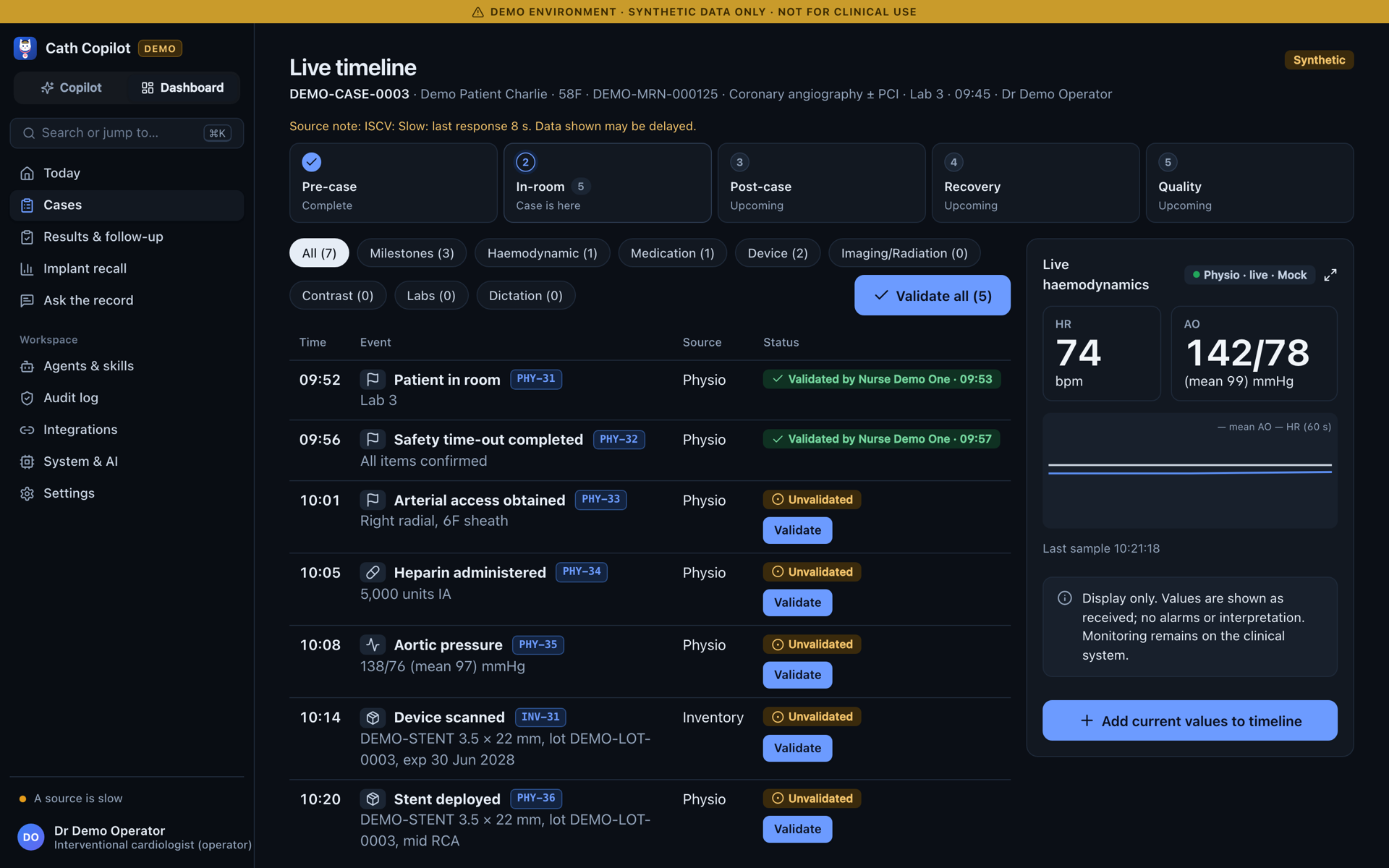
Cath Copilot's in-room timeline records the lab end of the interval from source systems: patient in room, safety time-out completed, arterial access obtained, device events such as balloon inflations from the physiology log or dictation, access closed and patient out of room, each with its time and source for the team to validate.
It does not record call-for-help or arrival times and does not calculate door-to-balloon or call-to-balloon, and its demo audit dataset has no timing fields. Those times come from ambulance and emergency department records and the national audit returns. Cath Copilot is a prototype on synthetic data only. It is not a medical device and is not for clinical use.
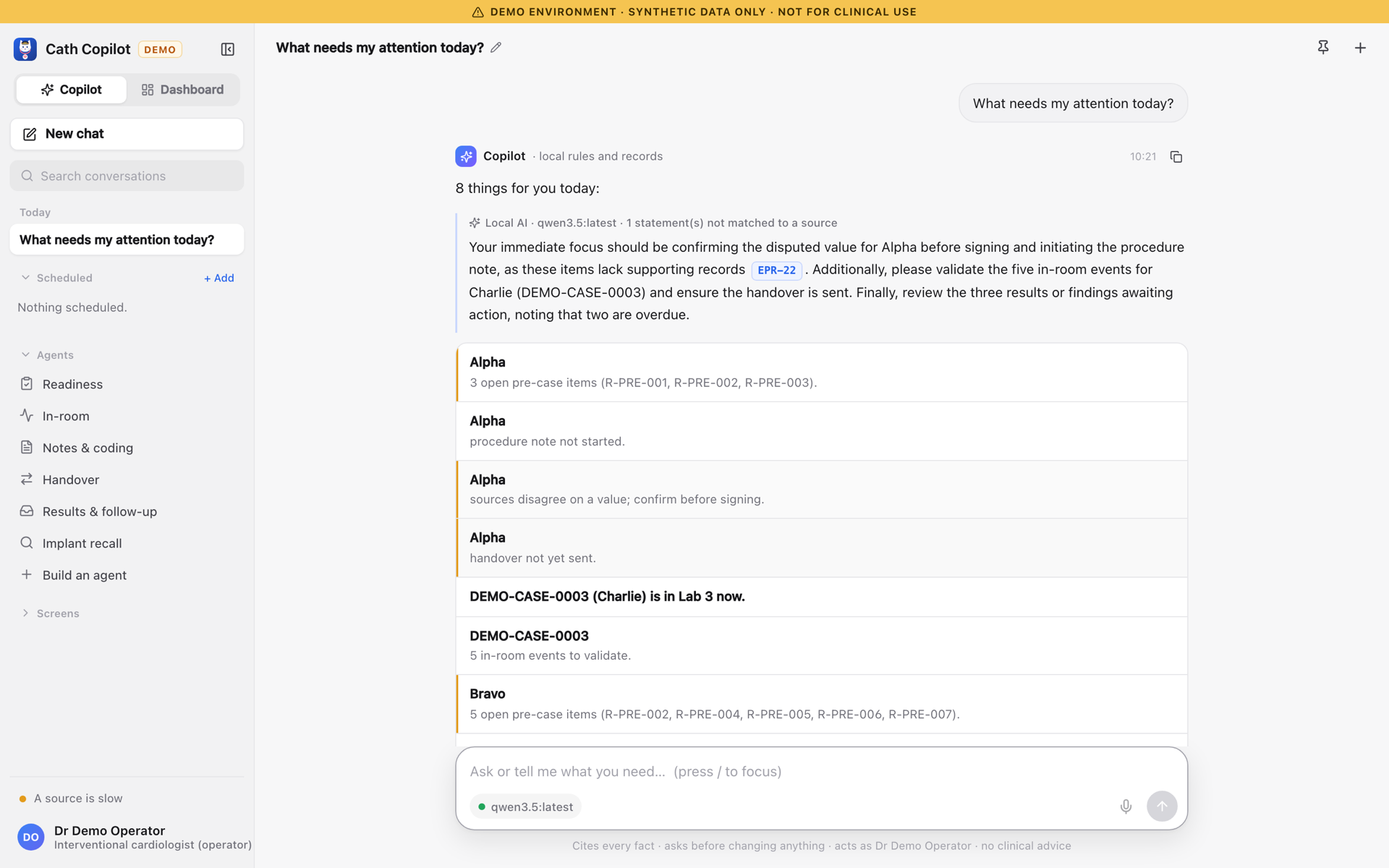 Cath Copilot: An AI copilot for the cath labWatch the demo on synthetic data, then see how it works →
Questions
What is a good door-to-balloon time?
The BCIS standard cited by NICE is that at least 75% of primary PCI patients should have a door-to-balloon time of less than 60 minutes.
What is the difference between door-to-balloon and call-to-balloon?
Door-to-balloon starts when the patient arrives at the primary PCI centre. Call-to-balloon starts with the first call for help, or arrival at the first hospital for people who self-present.
Which patients are excluded from the measures?
The NICE indicators, following the PCI dataset, exclude patients presenting in cardiogenic shock and those needing ventilation before PCI.
Sources
Official pages, checked November 2026. Guidance changes, so check the current version before you rely on it.
- NICE indicator IND73: Myocardial infarction, PCI in less than 60 minutes
- NICE indicator IND74: Myocardial infarction, PCI rates (call to balloon)
- NICE QS68 statement 6: Primary PCI for acute STEMI
- NICE NG185: Acute coronary syndromes, recommendations
- NICOR: National Audit of Percutaneous Coronary Interventions (NAPCI)
General information for healthcare managers and clinical teams, checked November 2026. It is not legal, regulatory or clinical advice; follow the current official guidance and your organisation's own policies. No patient data is used in these examples. Cath Copilot is a prototype running on synthetic data only. It is not a medical device and is not for clinical use. It recommends, drafts, and routes; it never diagnoses, orders, or decides. A clinical safety and information-governance process precedes any use with real patient data.