
Guide · checked November 2026
Cath lab requirements: room, equipment, staffing and governance
A cardiac cath lab needs a shielded procedure room of at least about 50 m² with an angiographic x-ray system, monitoring and support spaces, a trained multidisciplinary team with 24/7 cover where PCI is done, and governance covering IRR17 for staff, IR(ME)R for patients, safety checks and national audit. NHS England's HBN 01-01 and GIRFT's cardiology report are the main English references.
The room and its equipment
- A multi-angular digital angiographic x-ray system, single or biplane, with a C-arm, a fully adjustable patient table and ceiling-mounted monitors.
- Two workstations, one for the cardiac physiologist and one for the nurse, or one if the physiologist works from the control room.
- Scrub facilities, or a separate scrub-up and gowning room.
- A worktop for drug preparation and documentation, or a separate preparation room.
- Enclosed storage for equipment and consumables, including a catheter rack, and a wall-mounted controlled drugs cupboard.
- A heated cabinet for preparing contrast media and a power injector.
- Stimulators, ablators and mapping systems where electrophysiology studies and ablation are done.
HBN 01-01 says each catheter laboratory should accommodate:
Size and layout
HBN 01-01 recommends a minimum of 50 m² for the equipment and up to eight staff, the number needed for electrophysiology and ablation. Biplane equipment, needed for congenital work, electrophysiology studies and TAVI, may call for a longer room, and floor fixings must hold a moving mass of up to 3 tonnes. Its example schedules give one control room per lab (or a shared one per two labs), a trolley parking bay per lab, a resuscitation trolley bay per two labs, a dirty utility per four labs and 4 m² of storage per lab.
On location, HBN 01-01 says the suite should be close to day case admissions and recovery and to the coronary care unit, that the emergency access route should have priority if primary PCI is done, and that in tertiary centres it must be possible to move a patient to a cardiac theatre immediately.
Radiation
HBN 01-01 calls radiation shielding essential and says the design must comply with the radiation regulations; it cites the 1999 regulations, which IRR17 has since replaced. Under IRR17 the employer must consult a radiation protection adviser, designate controlled areas where special procedures are needed or staff are likely to exceed set dose levels, and write local rules. Patient exposures need IR(ME)R employer's procedures, entitlement and training records.
Staffing and cover
- Diagnostic angiography in PCI-capable labs, with access to mechanical support such as an intra-aortic balloon pump and protocols for escalation to surgery.
- Primary PCI delivered on a network basis by centres providing a 24/7/365 service, with rotas of at least one in six.
- Every hospital providing PCI has a cath lab team on a rota 24/7 to cover unplanned returns to the lab.
- Dedicated day case beds or a radial lounge, and a coronary care unit or high dependency unit in every hospital admitting acute cardiology patients.
- For pacing: GIRFT, citing the British Heart Rhythm Society, gives a minimum of 35 new implants a year for a pacemaker-only implanter, and at least two implanters doing at least 80 new implants a year per hospital implanting simple devices.
- For ablation: at least two active interventional electrophysiologists per centre, each doing at least 50 ablations a year as operator.
These points come from GIRFT's national cardiology report, which also sets out a four-level network model, from base services in every hospital to regional centres for TAVI and lead extraction.
Governance
- Local safety standards (LocSSIPs) written from NatSSIPs 2.
- Participation in the relevant national audits, such as NAPCI, NACRM and the TAVI registry.
- Device and implant traceability.
- Infection prevention and control in line with the national manual.
Common confusions
- HBN 01-01 is design guidance, not law, and parts of it predate IRR17.
- Requirements depend on the work: a device-only lab and a primary PCI centre need different cover.
- Equipment alone does not make a lab: rotas, recovery space and governance matter as much.
Where Cath Copilot fits
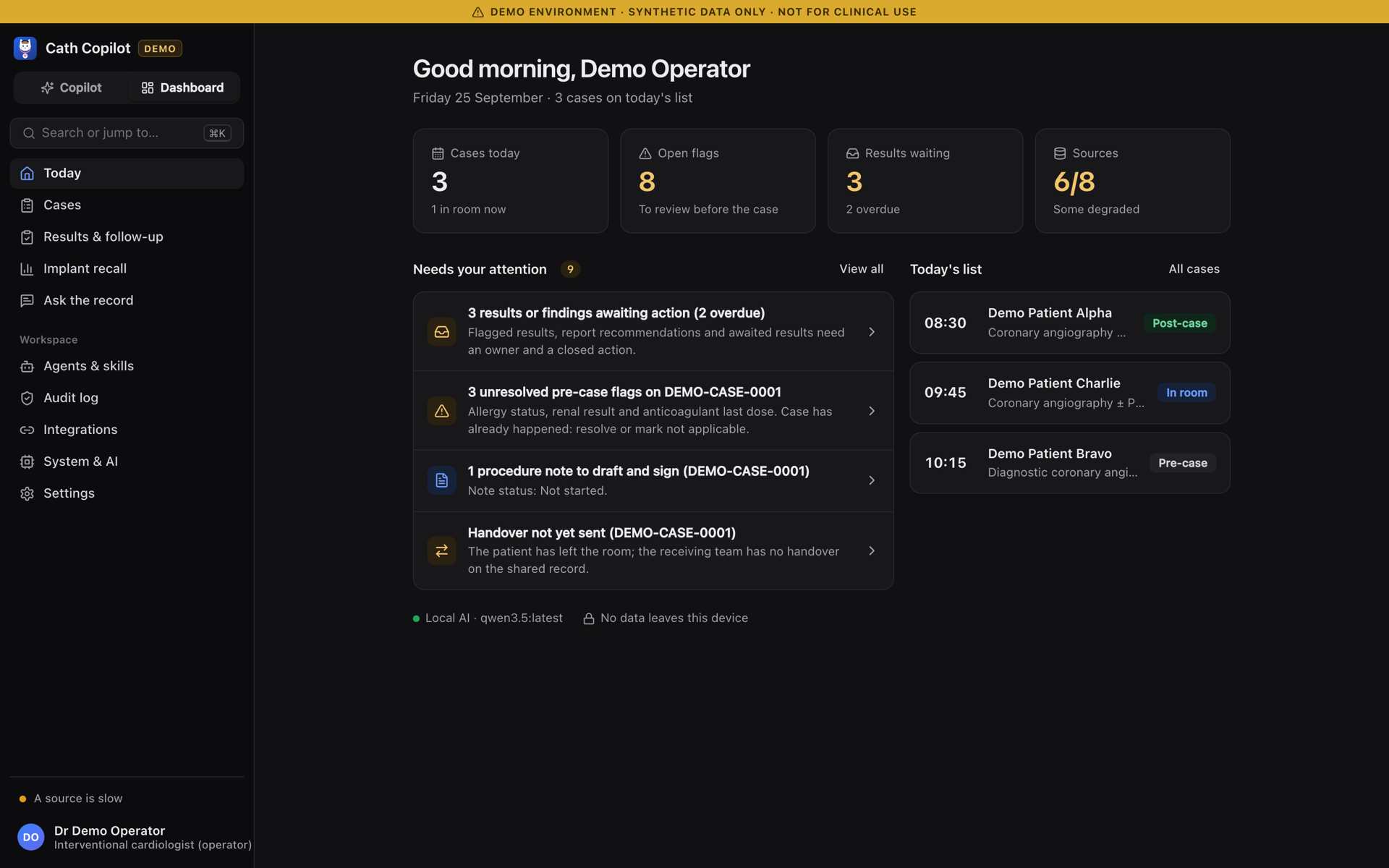
Cath Copilot does not help with building or equipment choices. It sits on top of the systems a lab already has, connecting to FHIR R4 servers, DICOMweb PACS, HL7 v2 feeds over MLLP with TLS and IEEE 11073 SDC monitors. It runs on one PC, as a lab host shared with the room, or against a server run by hospital IT, and its AI model runs locally through Ollama.
A clinical safety and information governance process would come before any use with real patient data. Cath Copilot is a prototype on synthetic data only. It is not a medical device and is not for clinical use.
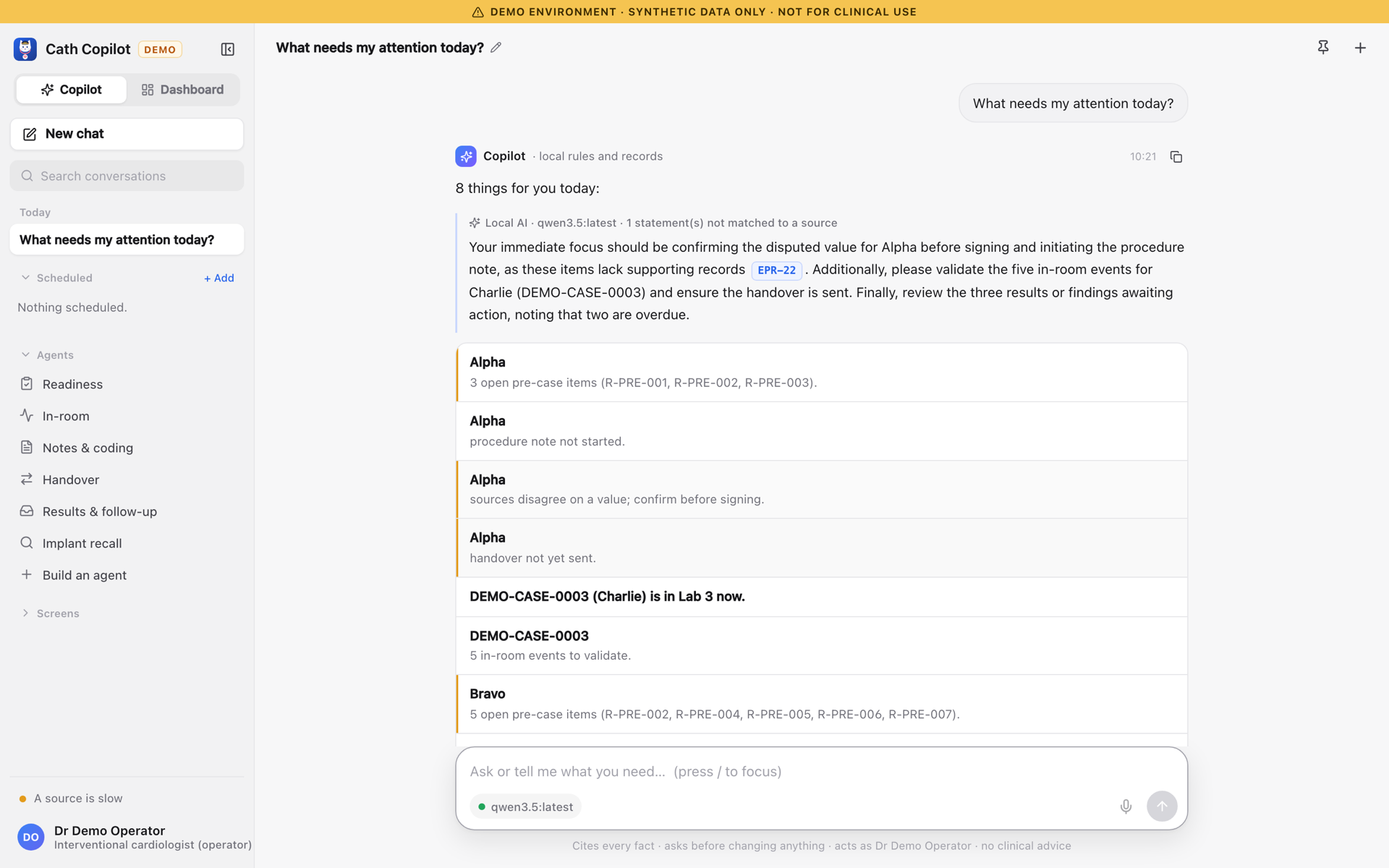 Cath Copilot: An AI copilot for the cath labWatch the demo on synthetic data, then see how it works →
Questions
How big should a cath lab be?
HBN 01-01 recommends a minimum of 50 m² for the equipment and up to eight staff; biplane rooms may need to be longer.
Which regulations apply to a cath lab?
IRR17 for staff and the public, IR(ME)R for patient exposures, plus health and safety law; HBN 01-01 gives design guidance.
Does every hospital need a cath lab?
No. GIRFT describes a network model in which every hospital has access to all levels of service, but more specialist procedures sit in network or regional centres.
Sources
Official pages, checked November 2026. Guidance changes, so check the current version before you rely on it.
General information for healthcare managers and clinical teams, checked November 2026. It is not legal, regulatory or clinical advice; follow the current official guidance and your organisation's own policies. No patient data is used in these examples. Cath Copilot is a prototype running on synthetic data only. It is not a medical device and is not for clinical use. It recommends, drafts, and routes; it never diagnoses, orders, or decides. A clinical safety and information-governance process precedes any use with real patient data.