Guide · checked November 2026
Staff radiation protection in the cath lab
Cath lab staff are protected by the Ionising Radiations Regulations 2017 (IRR17), not IR(ME)R. IRR17 requires employers to restrict exposure so far as reasonably practicable, first through engineering controls and design, then systems of work, then personal protective equipment; it sets annual dose limits including 20 mSv to the lens of the eye; and it requires workers likely to exceed set thresholds to be classified and their doses assessed by an approved dosimetry service.
IRR17 or IR(ME)R?
IR(ME)R 2017 applies to medical exposures: patients having their own diagnosis or treatment, health screening, research volunteers, carers and comforters, asymptomatic individuals and non-medical imaging. The radiation that staff receive at work falls under IRR17. Both apply in the same room at the same time, and they pull in the same direction: reducing the dose to the patient usually reduces scattered radiation reaching staff as well.
Dose limits for staff
- Effective dose: 20 mSv in a calendar year for employees aged 18 or over.
- Lens of the eye: 20 mSv in a calendar year or, under conditions approved by HSE, 100 mSv over five consecutive years with no more than 50 mSv in any one year.
- Skin: 500 mSv in a calendar year, averaged over any area of 1 cm².
- Extremities: 500 mSv in a calendar year.
These are the IRR17 Schedule 3 limits for adult employees. Different limits apply to trainees under 18 and to other people.
Classified workers and dosimetry
Under regulation 21, an employer must designate as classified persons employees who are likely to receive more than 6 mSv effective dose a year, more than 15 mSv to the lens of the eye, or more than 150 mSv to the skin or extremities. A classified person must be 18 or over and certified fit by a relevant doctor. Their doses must be assessed and recorded through an approved dosimetry service, and regulation 22 requires the records to be kept until the person is, or would have been, 75, and for at least 30 years.
HSE says employers' risk assessments should help decide whether personal monitoring is needed for other staff, and that employers should review dose summaries to spot unusually high doses or rising trends. Interventional cardiology is a common reason to look closely at eye-lens dose, because operators stand close to the patient.
The order of protection
- Engineering and design: room shielding, ceiling-suspended screens and table-mounted shielding.
- Systems of work: local rules, controlled areas, keeping exposure time down, and standing back from the x-ray tube side where the case allows.
- PPE: protective aprons, thyroid shields and protective eyewear, fitted and checked.
Regulation 9 sets the order. Employers must restrict exposure so far as reasonably practicable by engineering controls, design features, safety features and warning devices; then by systems of work; and then, where it further restricts exposure, by adequate and suitable personal protective equipment, taking reasonable steps to make sure it is used properly. Dose constraints are used at the planning stage where appropriate.
The people involved
Employers must consult a radiation protection adviser on matters including the designation of controlled areas, and appoint radiation protection supervisors to oversee the local rules. In practice the medical physics team, the lab's radiation protection supervisor and each member of staff share the work.
Common confusions
- A lead apron does not protect the eyes or the hands.
- Diagnostic reference levels are for patient doses, not staff doses.
- Being classified is a legal status that brings monitoring and medical surveillance, not a sign that someone is overexposed.
Where Cath Copilot fits
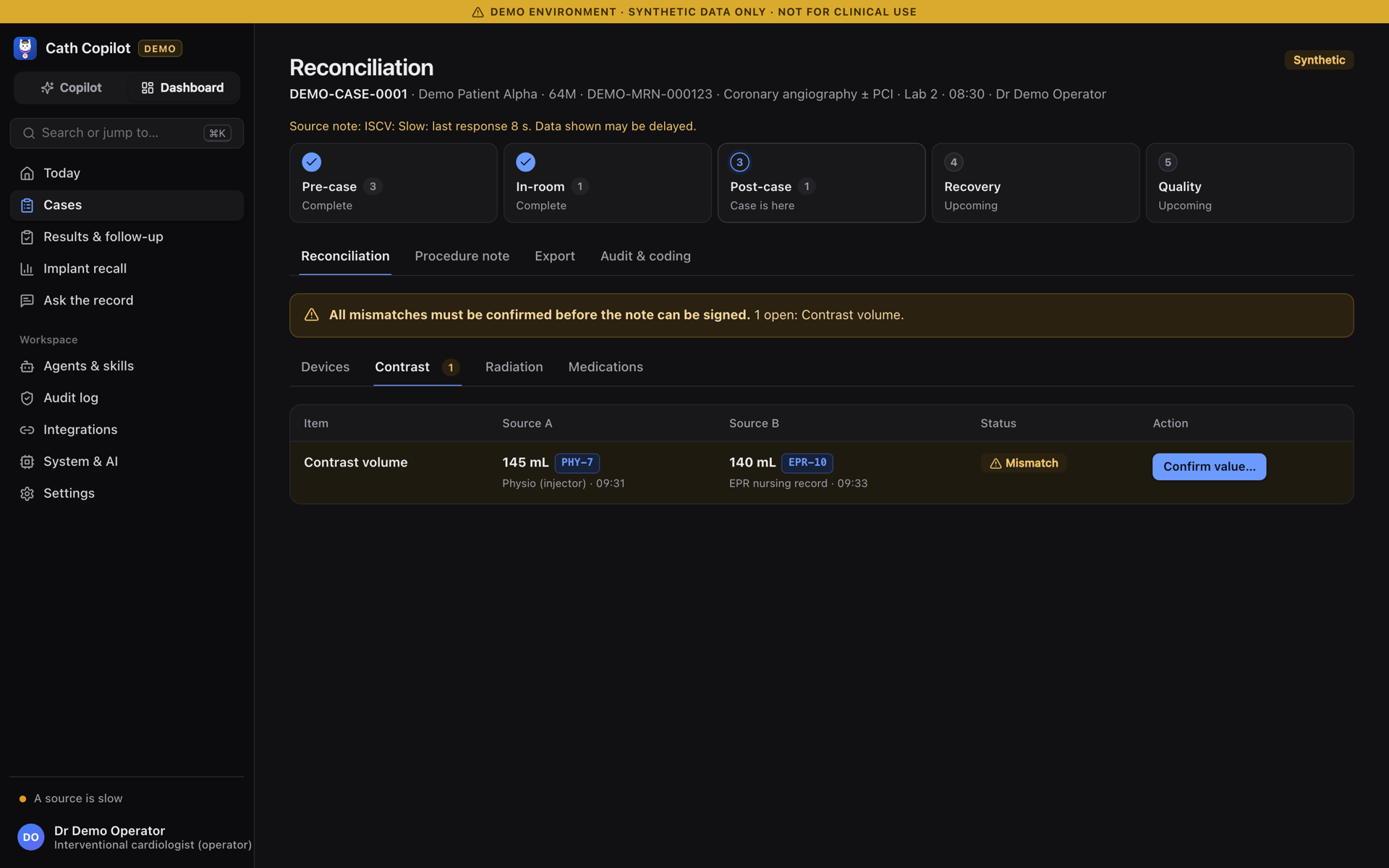
Cath Copilot records patient dose: dose-area product and fluoroscopy time from the x-ray system's dose report, checked against the value entered in the physiology system and carried into the note and audit return. Because lower patient dose tends to mean lower scatter, that record is a starting point for optimisation work.
It does not track staff dosimetry, classification, PPE checks or local rules. Cath Copilot is a prototype on synthetic data only. It is not a medical device and is not for clinical use.
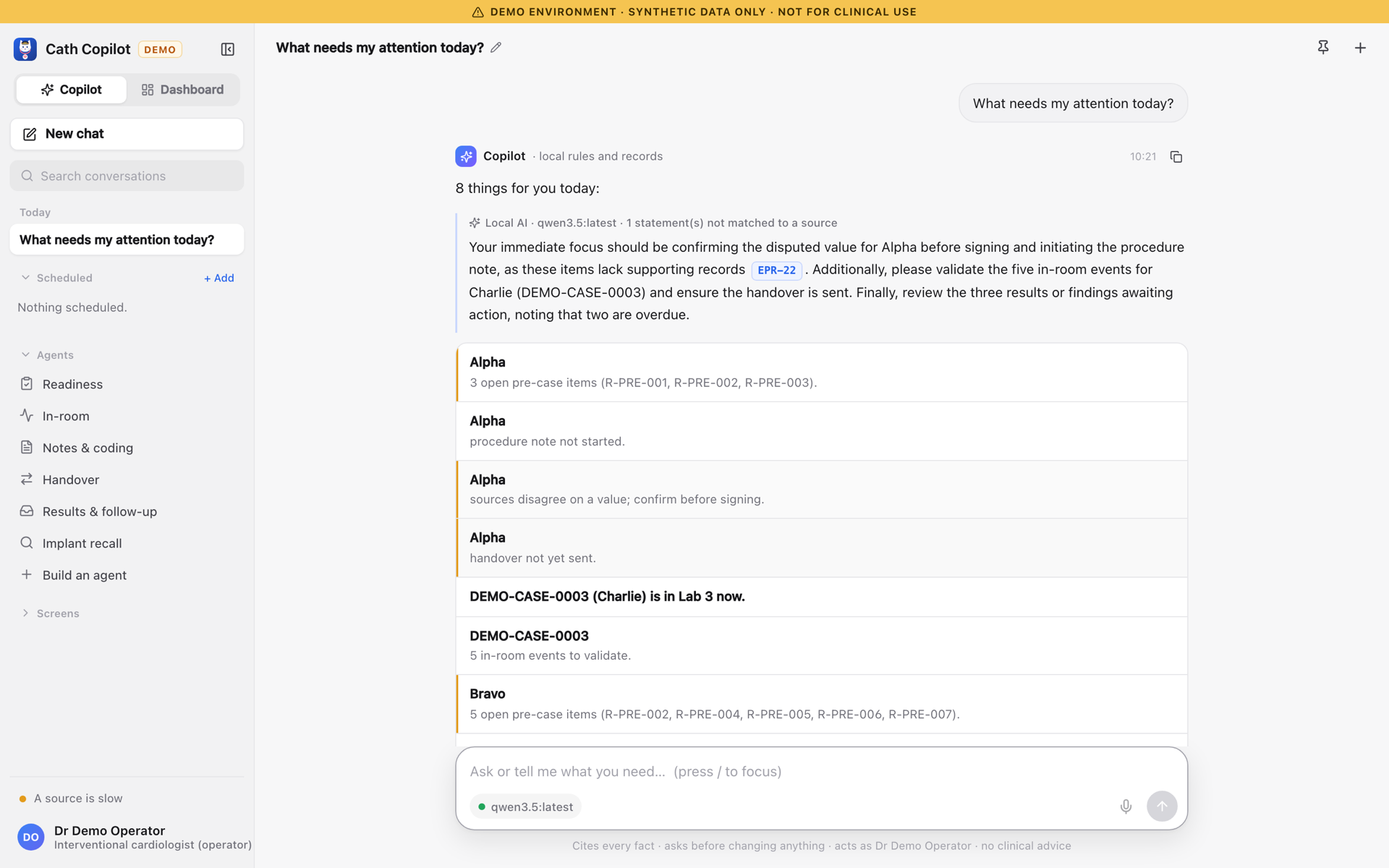 Cath Copilot: An AI copilot for the cath labWatch the demo on synthetic data, then see how it works →
Questions
What is the eye-lens dose limit for cath lab staff?
20 mSv in a calendar year for employees aged 18 or over, or 100 mSv over five consecutive years with a maximum of 50 mSv in any year, under conditions approved by HSE.
Who must be monitored with a dosimeter?
Classified persons must have their doses assessed by an approved dosimetry service. For other staff, the employer's risk assessment decides whether personal monitoring is needed.
Does IR(ME)R apply to staff dose?
No. IR(ME)R covers medical exposures such as patients' own procedures. Staff exposure at work falls under IRR17.
Sources
Official pages, checked November 2026. Guidance changes, so check the current version before you rely on it.
General information for healthcare managers and clinical teams, checked November 2026. It is not legal, regulatory or clinical advice; follow the current official guidance and your organisation's own policies. No patient data is used in these examples. Cath Copilot is a prototype running on synthetic data only. It is not a medical device and is not for clinical use. It recommends, drafts, and routes; it never diagnoses, orders, or decides. A clinical safety and information-governance process precedes any use with real patient data.