Guide · checked November 2026
Cath lab team roles: who does what
A cath lab case is run by a multidisciplinary team. The interventional cardiologist performs the procedure; cath lab nurses prepare and look after the patient, give medicines, scrub and assist; the cardiac physiologist runs ECG and pressure monitoring and records the procedure; and the radiographer acquires the x-ray images. Exact duties vary by unit, and IR(ME)R separately assigns radiation responsibilities to the referrer, practitioner and operator.
Interventional cardiologist (operator)
The cardiologist performs the procedure, makes the clinical decisions during the case and writes the findings and plan. GIRFT recommends that diagnostic angiography is done by a PCI-capable operator in a PCI-capable lab, so treatment can follow at the same sitting where it is needed. Under IR(ME)R the cardiologist is often entitled as the practitioner who justifies the exposure, and also as an operator for practical aspects such as screening.
Cath lab nurse duties
- Checking the patient in and running the pre-procedure checks with the team.
- Supporting the patient while they are awake on the table, and explaining what is happening.
- Giving medicines under local protocols, including sedation where it is used, and recording them.
- Scrubbing to assist the operator, or acting as the circulating nurse who opens equipment and records devices.
- Monitoring the patient's condition throughout the case.
- Care of the access site after the sheath is removed, recovery, and handover to the receiving ward.
Nursing roles in the lab vary with local practice and banding, so check your unit's job description. HBN 01-01 plans a nurse workstation in each lab. GIRFT encourages extended roles for advanced clinical practitioners and specialist nurses, such as seeing non-elective patients on arrival, consenting and pre-medicating them, and leading same-day discharge.
Cardiac physiologist
The physiologist records the ECG and intracardiac pressures and keeps the procedure log in the physiology system. The National School of Healthcare Science training curriculum includes preparing and maintaining good quality haemodynamic and ECG monitoring throughout a case in the cath lab, including setting up transducers and managing drift and artefacts. Physiologists also support device implants and electrophysiology work; HBN 01-01 plans a physiologist workstation and extra equipment where electrophysiology studies and ablation are done.
The Society for Cardiological Science and Technology (SCST) runs a cath lab course for all staff working in a cardiac cath lab, covering pressure measurement, waveforms, access, equipment and x-ray considerations, with an exam and a 50-case logbook.
Radiographer
The Society of Radiographers describes the radiographer in coronary angiography as responsible for imaging the heart in a number of projections to show each artery and any narrowing or blockage, and notes that many radiographers have extended their roles, for example injecting contrast. Radiographers are often entitled as IR(ME)R operators for practical aspects of the exposure.
Other members of the team
- Advanced clinical practitioners and specialist nurses with extended roles.
- Physician associates in anaesthesia or anaesthetists, where sedation or general anaesthetic is used.
- Healthcare assistants and support workers.
- The lab coordinator, who GIRFT says should run the lab using a scheduler.
Radiation duty holders under IR(ME)R
IR(ME)R regulation 10 sets out the duty holders. The practitioner is responsible for justifying an exposure; the operator is responsible for each practical aspect they carry out; the referrer must give the practitioner enough medical information to decide; and all must follow the employer's procedures and cooperate with other staff. These are functions, not job titles: the employer's procedures decide who is entitled to each.
Common confusions
- Job titles differ between units, and some use multi-skilled cath lab practitioners.
- "Operator" means one thing in the cath lab (the cardiologist) and another under IR(ME)R (anyone performing a practical aspect).
- Roles are set locally: no single national job description covers every lab.
Where Cath Copilot fits
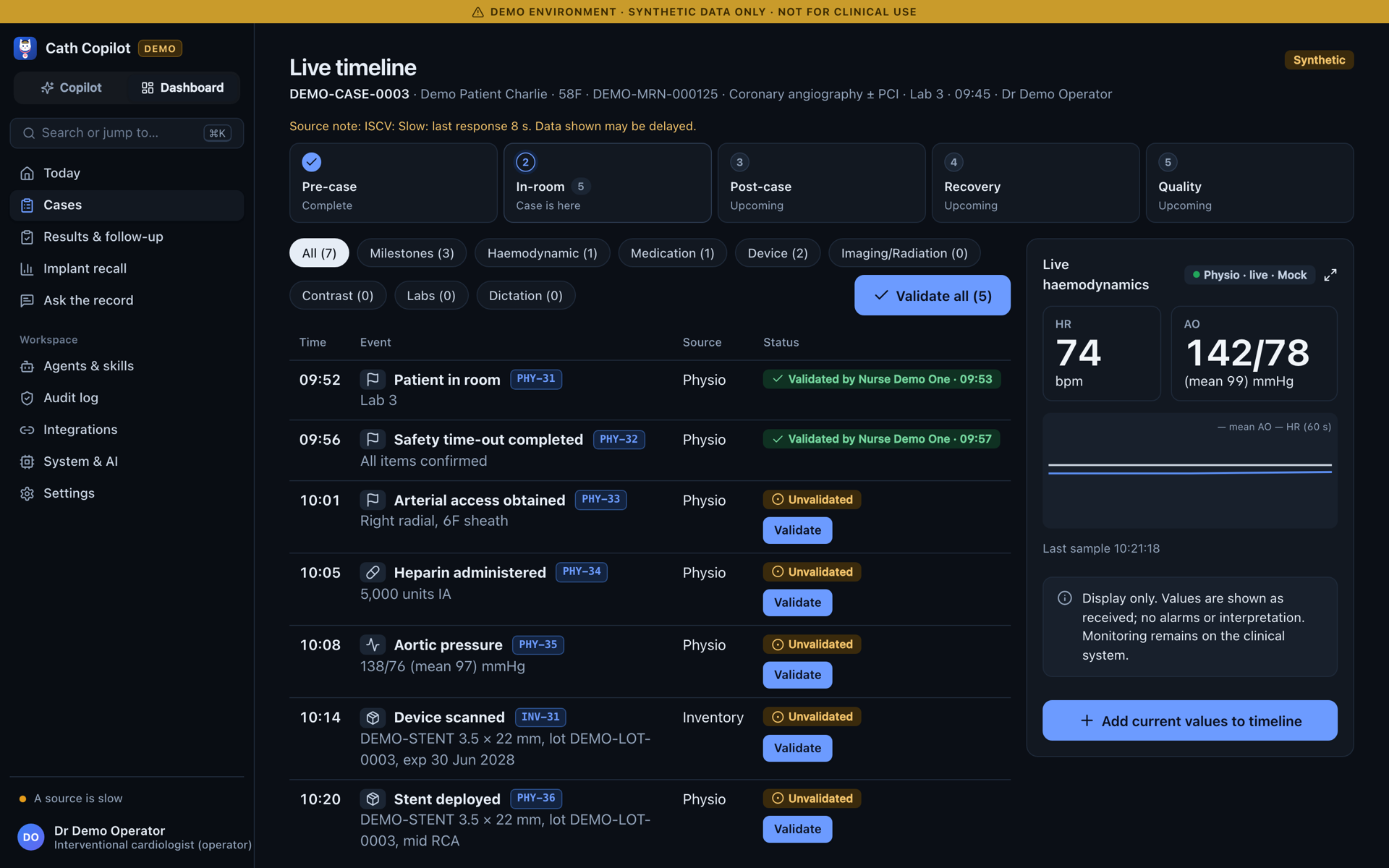
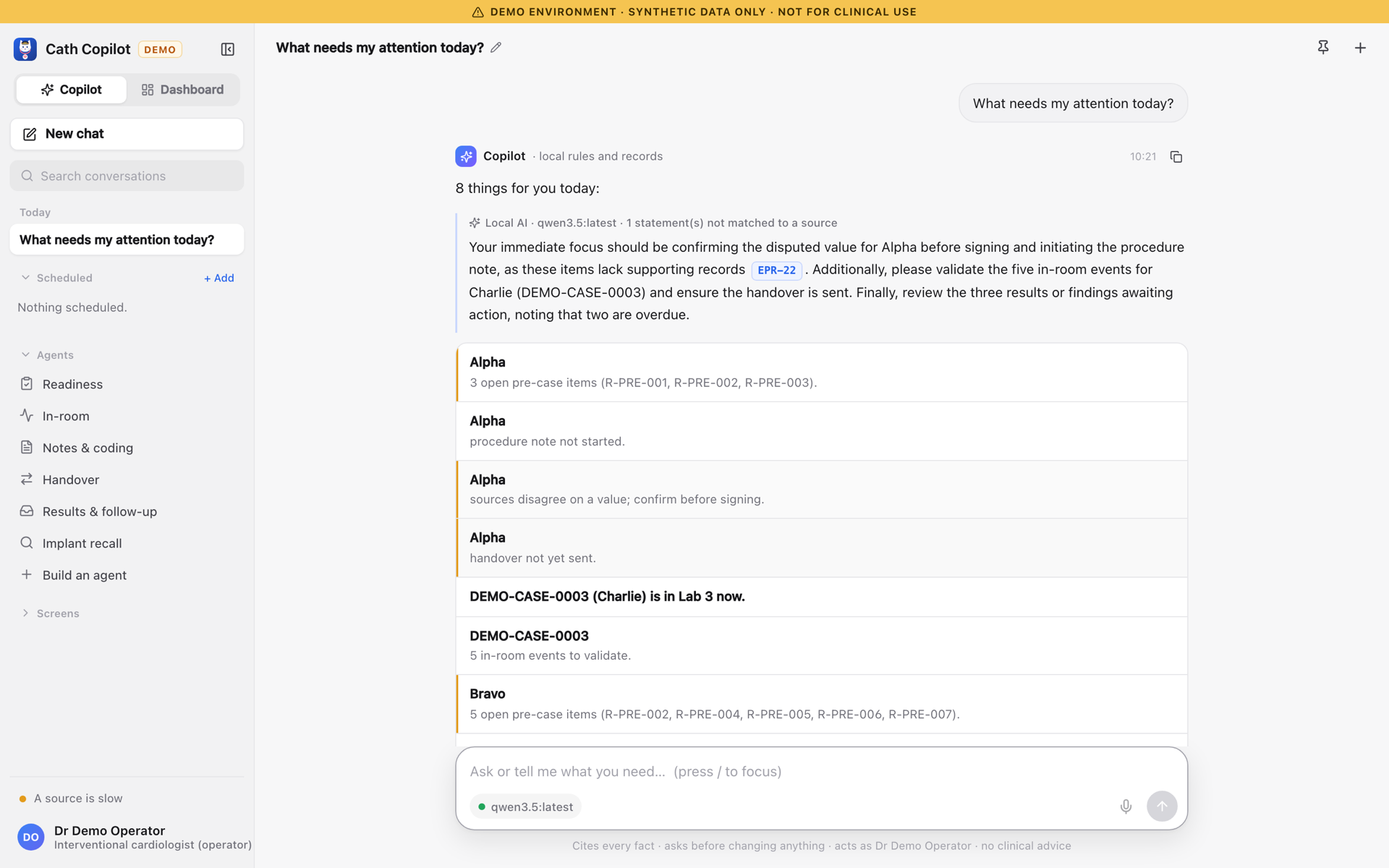
Cath Copilot's demo has seven roles that mirror a cath lab team, and each sees the same patient differently. The cath lab nurse can resolve flags, validate events, reconcile values and send or acknowledge a handover, but cannot read full RIS order details, imaging or dose reports, or sign notes. The physiologist validates events and reconciles values but cannot read the medicines chart, consent or the procedure note. The radiographer can read imaging, dose reports and RIS order details but not the medicines chart, consent, referral or live haemodynamics. Only the operator signs the note; the coordinator assigns flags; the quality lead exports audit data; site IT sees no patient data. A real site would set its own policy.
Cath Copilot is a prototype on synthetic data only. It is not a medical device and is not for clinical use.
 Cath Copilot: An AI copilot for the cath labWatch the demo on synthetic data, then see how it works →
Questions
What does a cath lab nurse do?
Usually: patient checks and support, giving medicines including sedation under local protocols, scrubbing or circulating, monitoring, access-site care, recovery and handover. Duties vary by unit.
Who is the IR(ME)R practitioner in a cath lab?
Whoever the employer's procedures entitle. It is often the cardiologist. The practitioner is responsible for justifying the exposure.
Is there a course for new cath lab staff?
SCST runs a cath lab course for staff working in a cardiac cath lab, with an exam and a logbook of 50 cases.
Sources
Official pages, checked November 2026. Guidance changes, so check the current version before you rely on it.
- legislation.gov.uk: IR(ME)R 2017 regulation 10, duty holders
- SCST: Cath Lab Course
- National School of Healthcare Science: cath lab monitoring training activity (STP cardiac)
- Society of Radiographers: The role of the radiography workforce in cardiac services
- GIRFT: Cardiology national specialty report (February 2021)
General information for healthcare managers and clinical teams, checked November 2026. It is not legal, regulatory or clinical advice; follow the current official guidance and your organisation's own policies. No patient data is used in these examples. Cath Copilot is a prototype running on synthetic data only. It is not a medical device and is not for clinical use. It recommends, drafts, and routes; it never diagnoses, orders, or decides. A clinical safety and information-governance process precedes any use with real patient data.