Guide · checked November 2026
List of procedures done in a cath lab
A cardiac cath lab is used for coronary angiography and angioplasty (PCI), pacemaker, ICD and other device implants, electrophysiology studies and ablation, and structural heart procedures such as TAVI and the closure of septal defects; some labs also host non-cardiac work such as neurovascular angiography. NHS England's building guidance for cardiac facilities, HBN 01-01, lists these as the procedures a cath lab may be used for.
Coronary procedures
- Coronary angiography: x-ray imaging of the coronary arteries. A thin tube (catheter) is passed from an artery in the wrist, arm or groin to the heart and contrast dye is injected so the arteries show on the images.
- Coronary angioplasty and stenting (PCI): a balloon, usually carrying a stent, is used to widen a narrowed or blocked coronary artery. NHS information says it is usually done under local anaesthetic, takes between 30 minutes and 2 hours, and is also used as emergency treatment after a heart attack.
- Primary PCI: emergency angioplasty for a STEMI heart attack, delivered around the clock.
- Intracoronary imaging and physiology, such as IVUS, OCT and FFR, used to look inside an artery or measure the pressure across a narrowing. GIRFT recommends that diagnostic angiography is done in PCI-capable labs so these are available without a second procedure.
- Pressure studies: left and right heart catheterisation to measure pressures inside the heart.
Heart rhythm procedures
- Pacemaker implantation: NHS information says a pacemaker is fitted by a cardiologist, usually under local anaesthetic, sometimes with sedation, and that it usually takes about an hour. Wires pass through a vein to the heart and the device sits under the skin near the collarbone. Leadless pacemakers are placed inside the heart through a vein.
- Implantable cardioverter defibrillators (ICDs) and cardiac resynchronisation therapy (CRT) devices, often called complex devices.
- Electrophysiology studies and catheter ablation, including ablation for atrial fibrillation, which use catheters to map the heart's electrical activity and treat the source of an abnormal rhythm.
GIRFT recommends day-case implantation under local anaesthetic with sedation as the default for elective cardiac devices, and notes that many atrial fibrillation ablations can be done safely under conscious sedation rather than general anaesthetic. It also says cardioversions should not routinely take place in a cath lab, and that insertable cardiac monitors can be implanted by physiologists or specialist nurses outside the lab.
Structural heart and other procedures
- Transcatheter aortic valve implantation (TAVI): replacing the aortic valve through a catheter rather than open surgery.
- Mitral valvuloplasty, and transcatheter mitral and tricuspid valve procedures.
- Closure of atrial and ventricular septal defects, and of a patent foramen ovale (PFO).
- Left atrial appendage occlusion (LAAO).
- Transoesophageal echocardiography (TOE), listed in HBN 01-01 among cath lab procedures.
- Non-cardiac work in some hospitals, such as neurovascular angiography and endovascular coiling.
HBN 01-01 notes that biplane x-ray equipment is needed for congenital heart treatments, electrophysiology studies and TAVI. GIRFT places TAVI, lead extraction and ventricular tachycardia ablation at regional level in its network model, so not every cath lab offers every procedure.
Which national audit covers what
NICOR's National Cardiac Audit Programme runs separate audits and registries for many of these procedures: the National Audit of Percutaneous Coronary Interventions (NAPCI), the National Audit of Cardiac Rhythm Management (NACRM), the Myocardial Ischaemia National Audit Project (MINAP), and registries for TAVI, transcatheter mitral and tricuspid valve procedures, left atrial appendage occlusion and PFO closure. Each has its own dataset, so the lab records different fields depending on the procedure.
Common confusions
- A cath lab is not an operating theatre, although hybrid cath labs, as GIRFT describes them, also work as operating suites.
- Angiography is not only cardiac: it can image blood vessels anywhere in the body.
- Not every lab does every procedure: the mix depends on the hospital's role in its network.
Where Cath Copilot fits
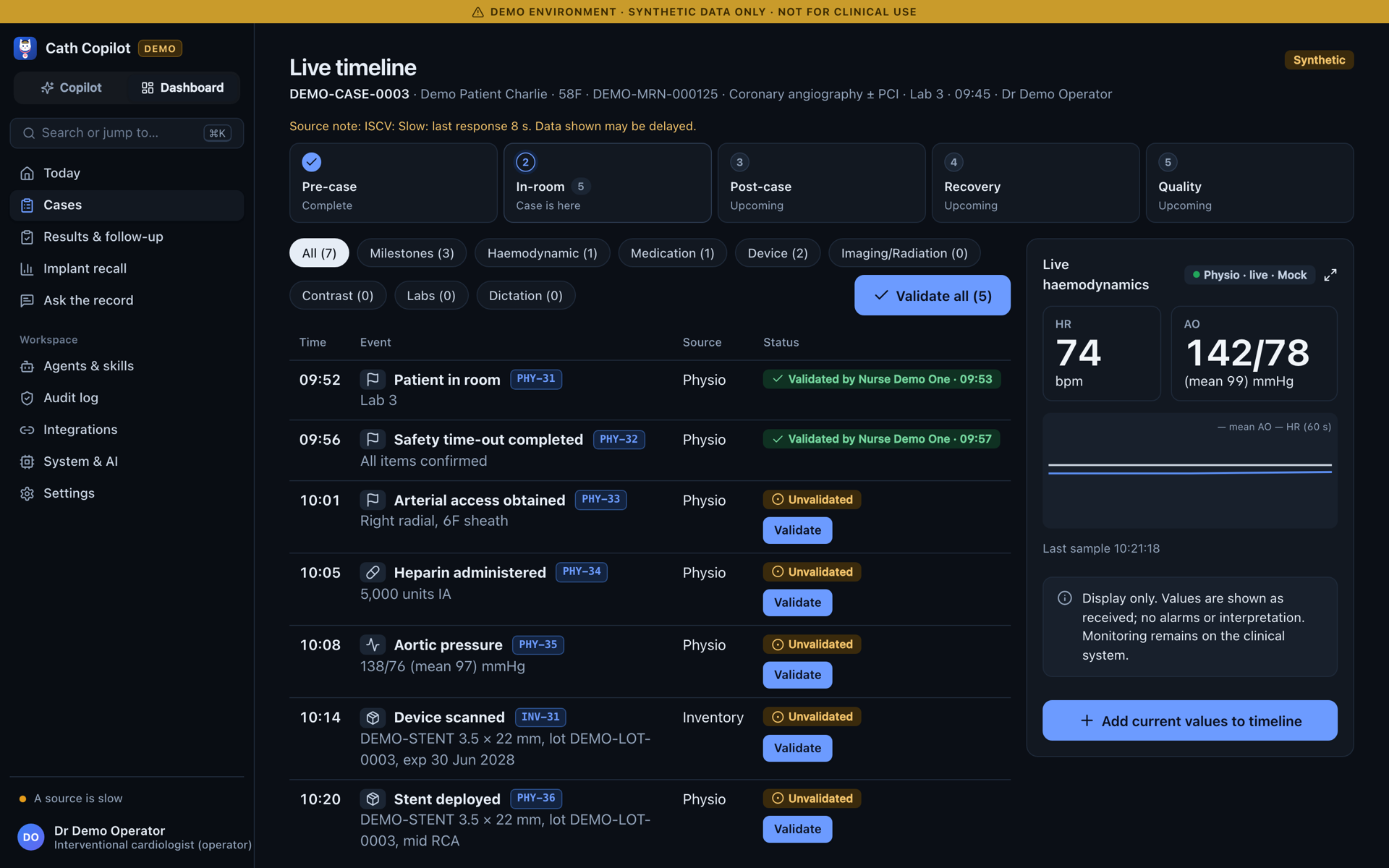
Cath Copilot's demo cases are coronary angiography with or without PCI. Its in-room timeline, reconciliation tabs for devices, contrast, radiation and medications, procedure note template and illustrative audit dataset are built around coronary cases. Implant recall search works across all cases for the devices recorded. Device, electrophysiology and structural workflows would need their own templates and audit mappings at a real site.
This page is general information, not clinical advice: the right procedure for a patient is a decision for their cardiology team. Cath Copilot is a prototype on synthetic data only. It is not a medical device and is not for clinical use.
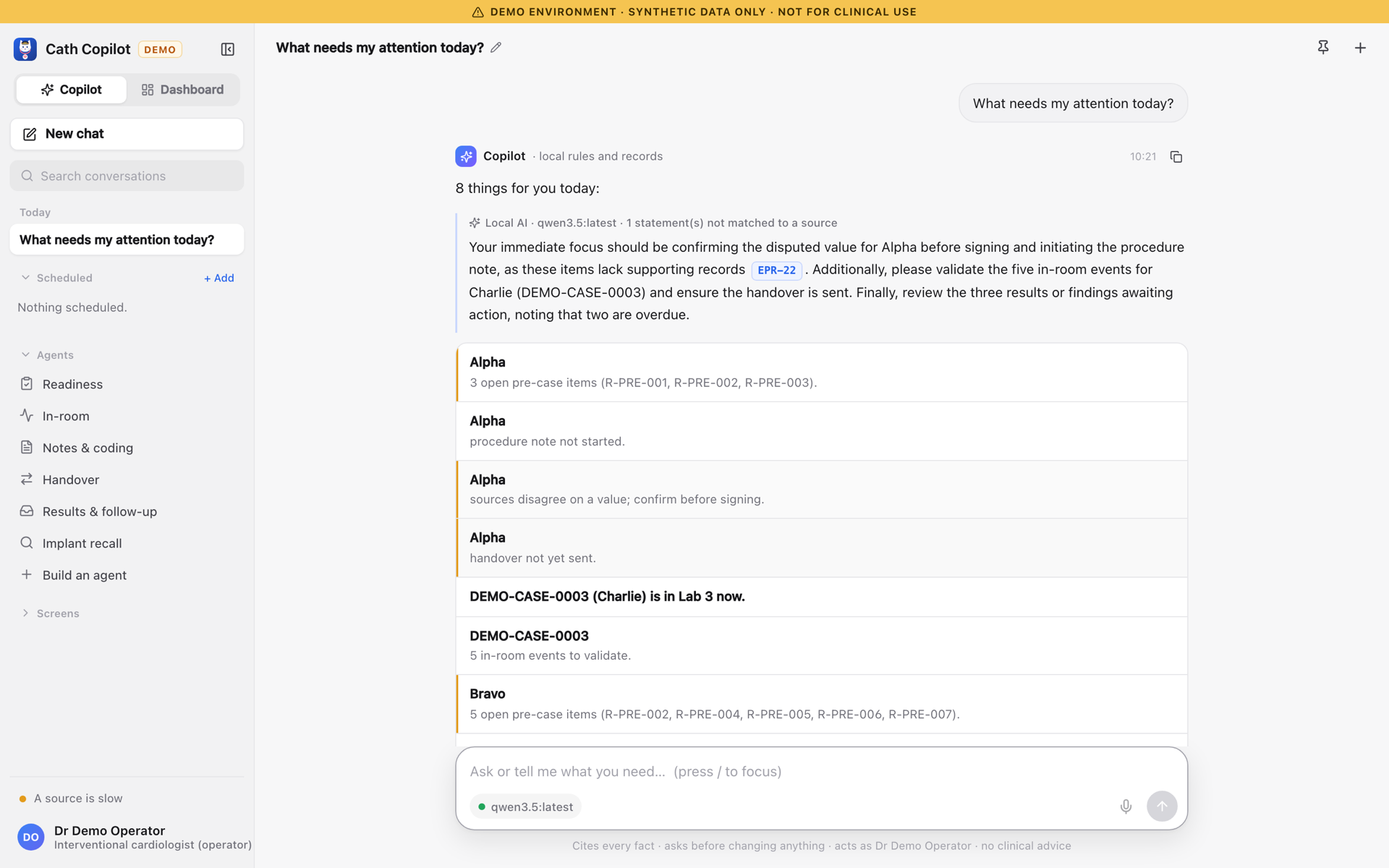 Cath Copilot: An AI copilot for the cath labWatch the demo on synthetic data, then see how it works →
Questions
Is a cath lab the same as an operating theatre?
No. NHS information says angioplasty usually takes place in a catheter lab, a room fitted with x-ray equipment, rather than in an operating theatre. Some hybrid labs also work as operating suites.
Are pacemakers fitted in the cath lab?
Often. HBN 01-01 lists ICDs and implantable devices among cath lab procedures, and GIRFT recommends day-case implantation as the default for elective devices.
Can this list tell me which procedure I need?
No. It is general information. Your cardiology team will explain which procedure is right for you and why.
Sources
Official pages, checked November 2026. Guidance changes, so check the current version before you rely on it.
General information for healthcare managers and clinical teams, checked November 2026. It is not legal, regulatory or clinical advice; follow the current official guidance and your organisation's own policies. No patient data is used in these examples. Cath Copilot is a prototype running on synthetic data only. It is not a medical device and is not for clinical use. It recommends, drafts, and routes; it never diagnoses, orders, or decides. A clinical safety and information-governance process precedes any use with real patient data.