
Guide · checked November 2026
Contrast volume and acute kidney injury in the cath lab
Record the total contrast volume as one confirmed value, the patient's recent kidney function before the procedure, and any creatinine checked afterwards. NICE guideline NG148 notes a small but increased risk of acute kidney injury (AKI) with an eGFR below 30, lists large contrast volumes and some intra-arterial injections among features of particularly high risk, and defines AKI by a creatinine rise of 26 micromol/litre within 48 hours or of 50% within 7 days.
What NICE NG148 says about iodine-based contrast
- Discuss the benefits and risks of tests or treatments that use iodine-based contrast with the person (1.1.5).
- Be aware of a small but increased risk of AKI with an eGFR below 30 ml/min/1.73 m² (1.1.6).
- Do not delay contrast in an emergency if the delay is likely to be clinically significant (1.1.7).
- For inpatients at particularly high risk, consider intravenous volume expansion with isotonic sodium bicarbonate or 0.9% sodium chloride. NICE's examples are an eGFR below 30, a renal transplant, a large contrast volume (higher than the standard diagnostic dose, or repeat administration within 24 hours) and intra-arterial contrast with first-pass renal exposure (1.2.8).
- Consider temporarily stopping ACE inhibitors and ARBs in adults with chronic kidney disease and an eGFR below 30 (1.2.9).
- Discuss care with a nephrology team before contrast for people on renal replacement therapy, without delaying emergency imaging (1.2.10).
NG148's recommendations on using an eGFR from the past six months and on screening questions are written for non-urgent contrast CT scans. Agree locally how they apply to cath lab procedures; this page is not clinical advice.
Detecting AKI afterwards
NG148 recommendation 1.3.1 defines AKI by any of: a rise in serum creatinine of 26 micromol/litre or more within 48 hours; a 50% or greater rise known or presumed to have happened within the past 7 days; or urine output below 0.5 ml/kg/hour for more than 6 hours in adults. Recommendation 1.1.1 lists iodine-based contrast within the past week among the reasons to check for AKI in an acutely ill adult, and 1.3.2 says creatinine should be monitored regularly in people with or at risk of AKI.
Since 2014, NHS England has asked acute trusts with pathology services to build a national AKI algorithm into their laboratory systems, so that potential AKI is flagged from laboratory results in real time. That flag only helps if someone owns the post-procedure result.
What to record
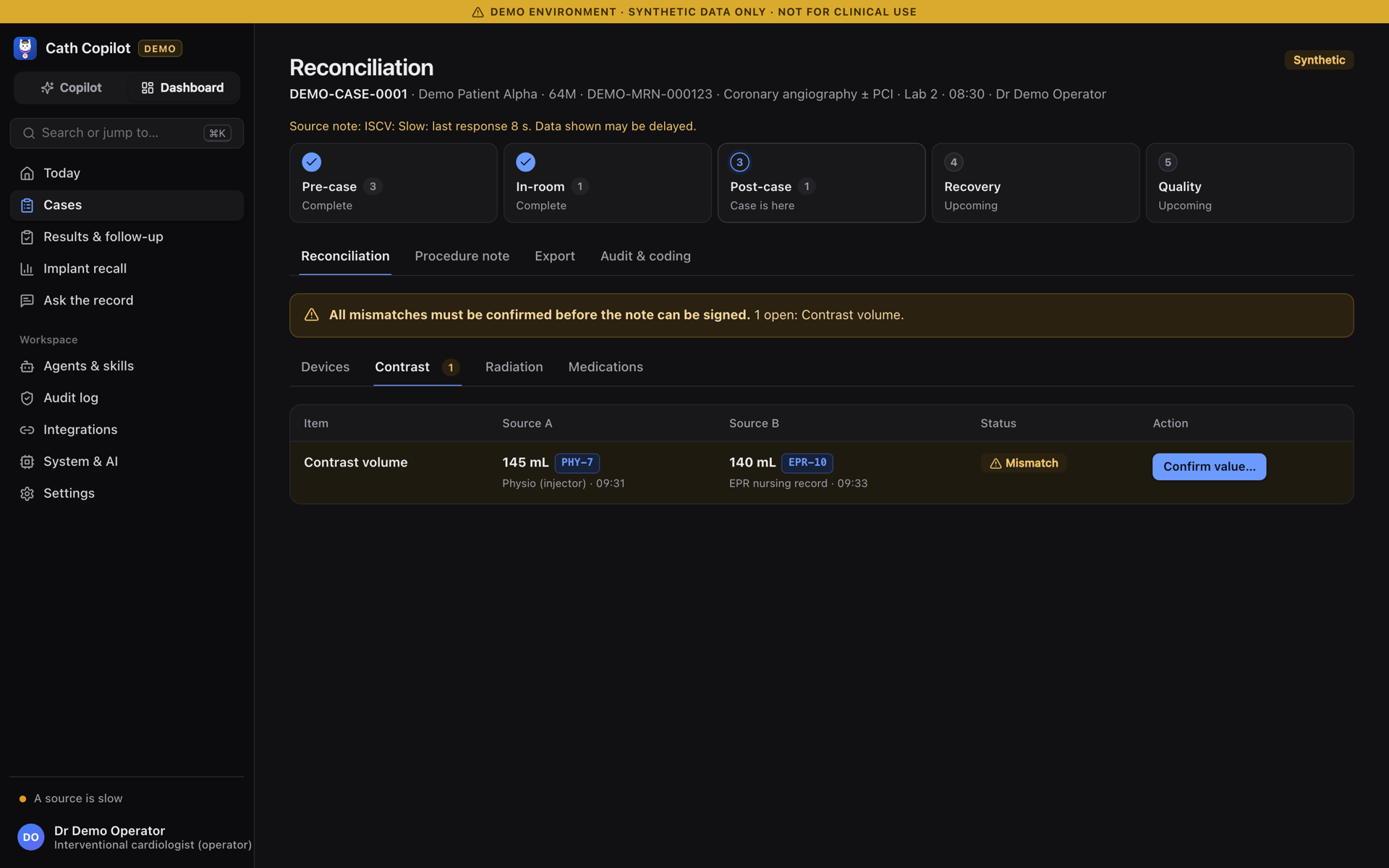
- The contrast agent and the total volume given, as one confirmed value. The injector and the nursing record often both hold a figure, and they can disagree.
- The most recent creatinine and eGFR before the procedure, with their dates.
- Weight, if your local contrast or medicines protocol uses it.
- Any hydration given and any changes to medicines such as ACE inhibitors and ARBs.
- Whether a post-procedure creatinine was ordered, who owns it, and the result.
Auditing it
- Was a kidney function result available within your local time window before the procedure?
- Is the contrast volume the same in the procedure note, the audit return and the handover?
- For patients at increased risk, was a post-procedure creatinine ordered, resulted and acknowledged?
- Were cases that met the AKI criteria reviewed?
Common gaps
- Two sources a few millilitres apart, and nobody confirms which one is right.
- An old eGFR treated as current.
- A creatinine ordered is not a creatinine resulted: the order can sit unnoticed.
Where Cath Copilot fits
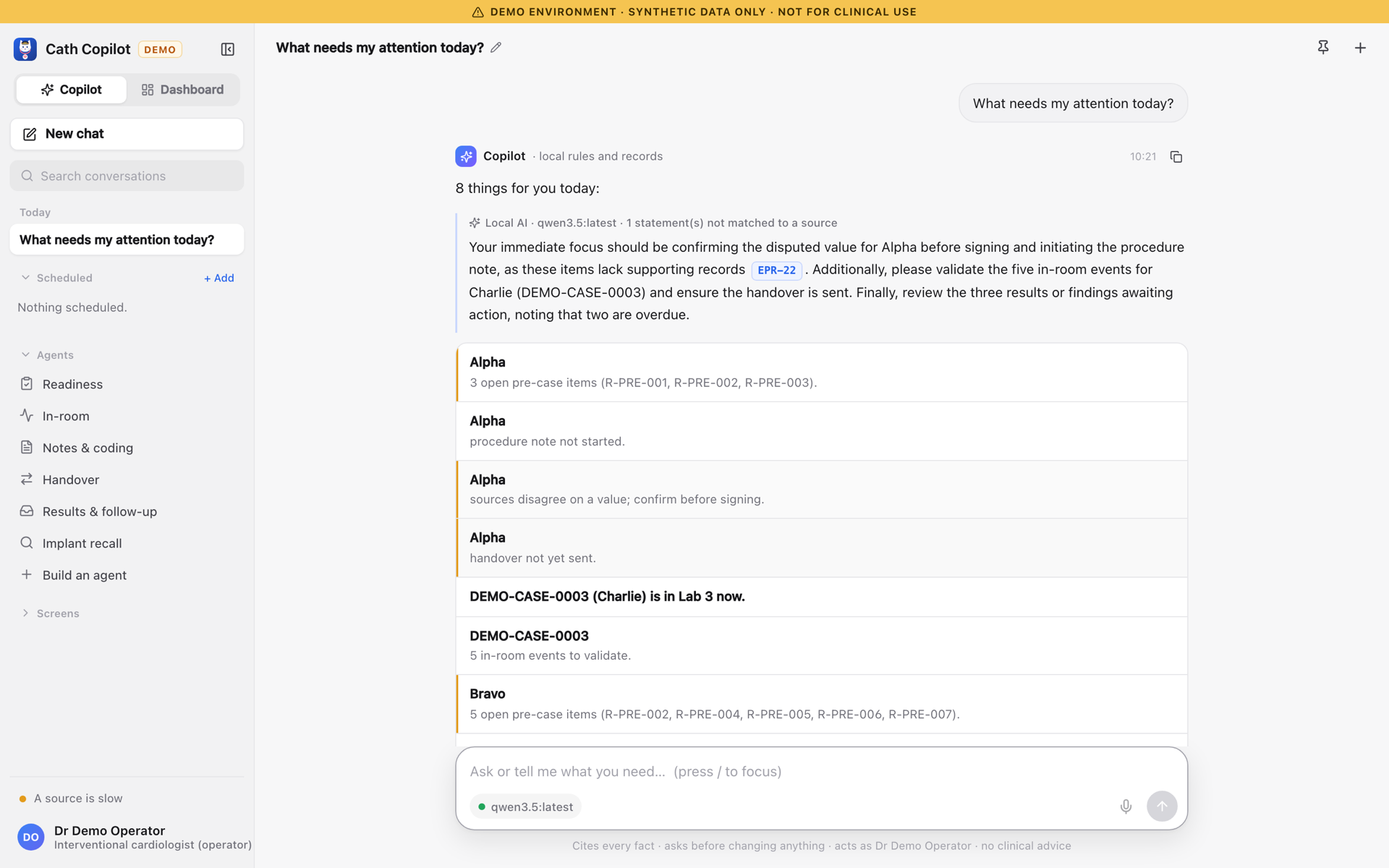
Cath Copilot's pre-case rules flag a creatinine or eGFR older than a locally set number of days, or missing, and a missing weight; a lab order never counts as a result. In the reconciliation step, a contrast mismatch such as 145 mL on the injector against 140 mL in the nursing record must be confirmed, with a reason, before the note can be signed, and the confirmed value feeds the note, the audit return and the handover. After the case, an awaited post-procedure creatinine is tracked as a result item with an owner until a named person closes it, and a flagged result arriving from the lab system replaces it without a reload.
The rules are illustrative and need local clinical governance approval, and the assistant declines questions such as whether a patient's renal function is fine for contrast. Cath Copilot is a prototype on synthetic data only. It is not a medical device and is not for clinical use.
 Cath Copilot: An AI copilot for the cath labWatch the demo on synthetic data, then see how it works →
Questions
What eGFR increases the risk of contrast-associated AKI?
NICE NG148 says to be aware of a small but increased risk of acute kidney injury with an eGFR below 30 ml/min/1.73 m².
How is acute kidney injury defined?
NG148 uses a creatinine rise of 26 micromol/litre or more within 48 hours, a rise of 50% or more within 7 days, or urine output below 0.5 ml/kg/hour for more than 6 hours in adults.
Does Cath Copilot decide whether contrast is safe?
No. It flags missing or old results and tracks the follow-up; the clinical decision stays with the team.
Sources
Official pages, checked November 2026. Guidance changes, so check the current version before you rely on it.
General information for healthcare managers and clinical teams, checked November 2026. It is not legal, regulatory or clinical advice; follow the current official guidance and your organisation's own policies. No patient data is used in these examples. Cath Copilot is a prototype running on synthetic data only. It is not a medical device and is not for clinical use. It recommends, drafts, and routes; it never diagnoses, orders, or decides. A clinical safety and information-governance process precedes any use with real patient data.